CheckNumber.AI
· 4 min read
Should Contacts Sharing One Phone Number Be Merged?
Treat a repeated number as one possible check input, while keeping each contact and relationship separate until independent evidence supports a merge.
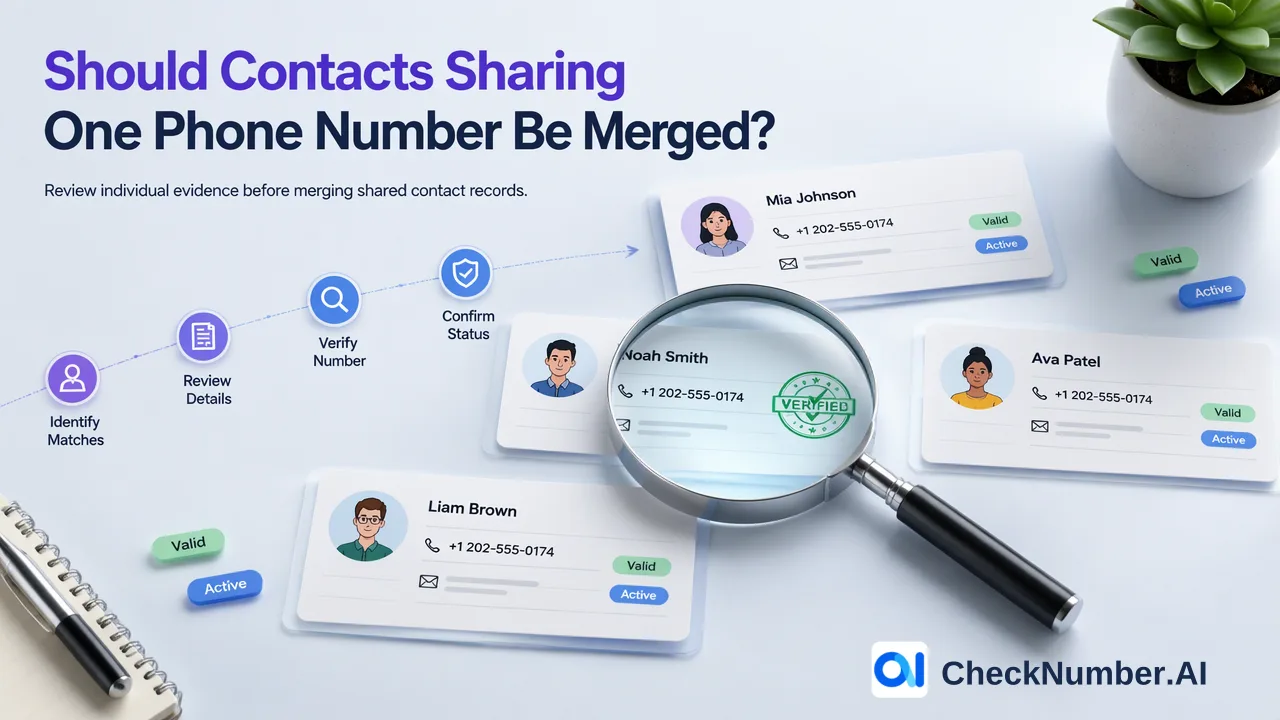
Contacts sharing one phone number should not be merged on that fact alone. A family line, office switchboard, or reassigned number can connect distinct people to the same digits. Deduplicate the number submitted for a check if appropriate, but preserve every contact-to-number relationship and decide on a record merge using independent, current evidence.
A phone value and a contact record answer different questions
A CRM contact represents a person or organization with its own history, consent records, and relationship to the business. A phone value is one contact route attached to that record. The same value can be attached to several contacts without making those contacts identical. Google’s libphonenumber falsehoods list documents that phone numbers are not reliably unique or permanent identifiers for people. A business main line can route to multiple employees; a household can also share a line. Numbers may change hands over time.
The practical rule is to separate two decisions. First, should the team send a particular number once for a number-level check? Second, should two CRM records become one? The first is an input-preparation decision. The second changes the meaning and history of contact records and needs stronger evidence. Treating a repeated phone field as an automatic merge key confuses the two.
Map every occurrence before deduplicating the upload
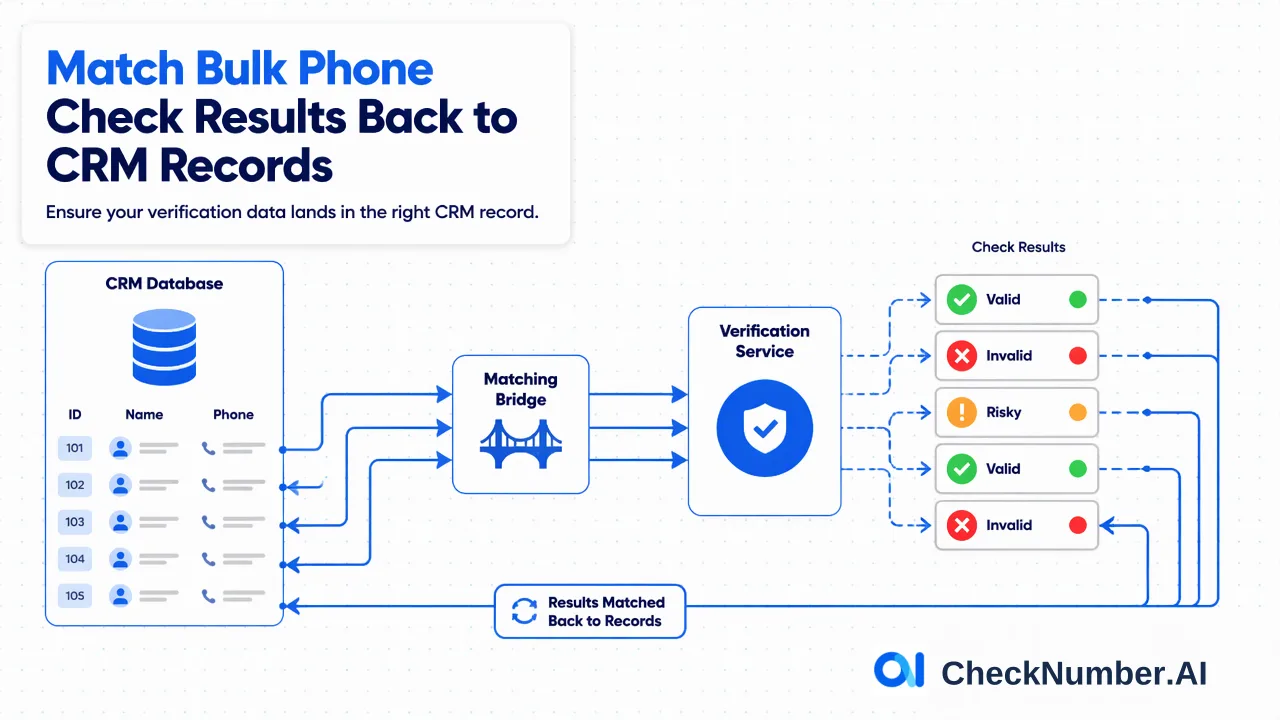
Export stable CRM record IDs, the phone field name, the raw number, and any country context the source actually stores. Assign an occurrence ID to each record-and-field pair. Preserve this table even if several entries normalize to the same international number. A single contact with a mobile and an office phone produces two occurrences. Three contacts using a company switchboard produce three occurrences that may point to one normalized number.
Normalize candidates consistently and send uncertain local numbers to a human review queue rather than guessing a country. CheckNumber.AI documents a bulk phone-list workflow with CSV or TXT uploads, one country per file, and one number per line including the country code; the plus sign is optional. Its Number Cleaner can normalize to E.164 and remove duplicates and invalid entries before a paid check. Those are preparation and checking capabilities, not CRM identity matching. Keep the original CRM values and a local mapping from each submitted number to every occurrence ID.
Use the result at number level, then review the people separately
After a check, associate each exported number-level result with the normalized input key and expand the local map back to the relevant CRM occurrences. Keep the selected checker and check date with the result. Different products provide different signals: a validity signal, a platform registration signal, and an activity signal do not mean the same thing. A platform registration signal can inform platform-specific reachability and deliverability at check time; it does not establish identity, ownership, consent, or a future response.
Suppose two employees list the same office main line. One number-level result may be relevant to both phone fields, but it says nothing about whether the employee records should be combined. Conversely, if one person has two numbers, each number may need its own result and review. These are illustrative CRM situations, not reported customer outcomes. Do not overwrite individual consent or contact preferences with a shared number result.
Require independent evidence before a CRM merge
A merge can be appropriate when independent identifiers and current source records show that two entries describe the same entity. Compare durable CRM IDs where available, verified source-system identifiers, names and organization context, and record histories. A matching name alone can also be ambiguous. Resolve conflicts in ownership, permissions, and activity history before a merge; preserve a reversible audit trail of the decision. HubSpot’s import guidance describes unique identifiers as the basis for recognizing and updating records, which illustrates why a phone field should not carry the whole identity decision.
When evidence remains mixed, retain separate records and annotate the shared number relationship. For a reused or reassigned number, review whether the link is still current rather than assuming the old association persists. The next practical step is to build the local number-to-record map, then choose the appropriate Number Checker product for the number-level question. Keep CRM merging as a separate reviewed operation.
FAQ
Can one checked result be linked to several contacts?
Yes. Keep a local mapping from the checked number to every distinct source record and phone field. The shared result remains a number-level signal, not proof that the contacts are the same person.
Does a repeated number always mean a duplicate CRM record?
No. Shared lines and changing number assignments make that inference unsafe. Review independent identifiers and record history before merging.