CheckNumber.AI
 · 6 min read
Registration vs. Activity: A Framework for WhatsApp Contact Verification
A technical guide explaining the difference between WhatsApp registration checks and activity signals, and how to operationalize these verification workflows for better contact list management.
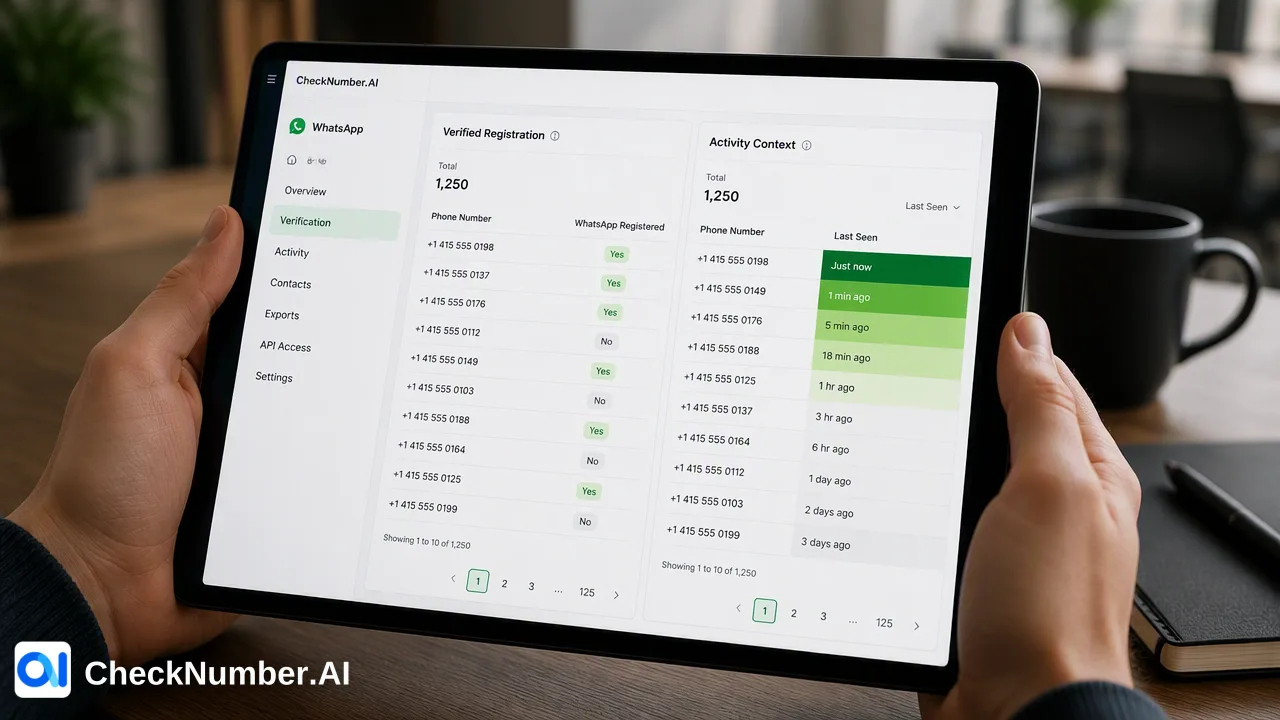
A WhatsApp registration check confirms whether a specific phone number is currently associated with a WhatsApp account, establishing basic platform presence. In contrast, an activity check provides additional context regarding account usage, such as available last-seen status or account duration. When managing contact lists, businesses typically use a registration check for foundational list hygiene to identify which numbers have a presence on the platform. Activity signals are then used to inform prioritization, helping teams focus their outreach efforts on contacts with recent engagement context. Understanding the distinction between a whatsapp registration check vs activity check supports more efficient CRM management and communication workflows.
Understanding WhatsApp Verification Signals
When evaluating contact lists for messaging workflows, teams must distinguish between basic platform presence and deeper usage context. The two primary verification signals serve distinct operational purposes. The Registration Check A registration check is a foundational signal that confirms whether a phone number is currently registered on the WhatsApp platform. It provides a binary data point: the number either has an associated account or it does not. This signal is strictly about platform presence. The Activity Signal An activity signal builds upon the basic registration check by providing context on how the account is used. This can include data points such as the available last-seen status or the account duration. The CheckNumber.AI WhatsApp Days Checker, for example, checks WhatsApp account presence and provides available activity or last-seen context, alongside available business-account and profile context. These signals add a layer of operational intelligence, shifting the focus from simple presence to contextual engagement. By separating these two concepts, technical and business teams can design more nuanced workflows that apply the right level of verification at the appropriate stage of the customer lifecycle.
When to Use Registration Checks
Registration checks are the standard tool for foundational CRM hygiene and initial list processing. Before initiating any large-scale communication effort, teams need to identify which contacts actually have a presence on the target platform. Cleaning CRM Lists Over time, customer databases accumulate outdated or incorrectly formatted phone numbers. Running a registration check helps teams filter out numbers that are not associated with a WhatsApp account. This process supports cleaner data management and prevents systems from attempting to route messages to non-existent accounts. Initial Workflow Filtering In a multi-channel communication strategy, knowing platform presence informs routing decisions. If a registration check indicates a number is not on WhatsApp, the workflow can automatically route the communication to an alternative channel, such as SMS or email. This basic presence detection is a low-friction way to segment a broad contact list into platform-specific cohorts. Because registration checks focus solely on account presence, they are highly efficient for processing large volumes of data where the primary goal is simply to establish whether a contact is theoretically present on the platform.
Leveraging Activity Signals for Prioritization
While registration checks establish the baseline of platform presence, activity signals provide the context necessary for strategic prioritization. Knowing that an account exists is helpful; knowing that the account has recent activity context supports more sophisticated decision-making. Contextualizing Contact Engagement Activity signals, such as last-seen status, offer a window into the account’s usage patterns. For instance, a contact list might contain thousands of registered numbers, but activity data can help identify which of those accounts have recent activity context versus those without it. The WhatsApp Days Checker provides this activity context, which can be a critical input alongside other internal checks. Supporting Outreach Prioritization When resources are limited or when managing high-value campaigns, teams can use activity signals to prioritize their efforts. Contacts with recent activity context may be prioritized for immediate outreach, while accounts lacking recent signals might be placed in a secondary queue or targeted with a different engagement strategy. Enriching Business Profiles In addition to activity data, advanced checks can provide available business-account and profile context. This enrichment helps teams differentiate between standard user accounts and business profiles, further informing how the contact should be managed within the CRM. By integrating these deeper signals, businesses can move beyond basic list cleaning and develop highly prioritized, context-aware communication workflows.
Operationalizing Your Verification Workflow
Implementing a whatsapp registration check vs activity check strategy requires integrating these signals into existing business systems at scale. CheckNumber.AI supports these operational requirements through flexible bulk processing capabilities. Bulk Processing Capabilities The core workflow for managing large contact databases is the bulk checking of supported phone-number lists. Rather than verifying numbers individually, teams can process entire segments of their CRM simultaneously. Bulk workflows support CSV or TXT list uploads, making it straightforward for non-technical users to clean and enrich their data without writing code. REST API Integration For automated, programmatic workflows, REST API access allows developers to integrate verification signals directly into their backend systems. This means a registration or activity check can be triggered automatically when a new contact is added to the CRM, or as a scheduled maintenance task before a campaign launch. Designing the Workflow A best-practice implementation typically involves a two-tiered approach:
- Tier 1 (Hygiene): Run a bulk registration check via CSV upload or API to filter out numbers without a platform presence.
- Tier 2 (Prioritization): For the remaining registered numbers, utilize the WhatsApp Days Checker to gather activity, last-seen, and profile context.
- Tier 3 (Action): Route the enriched data back into the CRM to inform segmentation and prioritization rules. By operationalizing these checks through bulk uploads and REST API integrations, organizations can maintain high data quality and support communication workflows informed by accurate platform signals.
FAQ
What is the difference between a registration check and an activity check?
A registration check confirms whether a specific phone number is currently associated with a WhatsApp account, establishing basic platform presence. An activity check provides additional context regarding account usage, such as available last-seen status or account duration. While registration is used for basic list hygiene, activity signals help teams prioritize contacts based on engagement context.
Can I perform these checks in bulk?
Yes, the core workflow for managing large contact lists is bulk checking. CheckNumber.AI bulk workflows support CSV or TXT list uploads for manual processing, as well as REST API access for automated integration into existing CRM or backend systems.
How do activity signals help with contact prioritization?
Activity signals provide context on how an account is used, such as its last-seen status. The WhatsApp Days Checker provides this activity context alongside available business-account and profile information. This data supports prioritization by allowing teams to focus their outreach on contacts with recent activity context, rather than treating all registered numbers equally.