CheckNumber.AI
 · 6 min read
Beyond Registration: A Framework for Evaluating WhatsApp Account Quality
A comprehensive framework for evaluating WhatsApp account quality beyond basic registration checks, utilizing activity signals and profile enrichment to support targeted outreach.

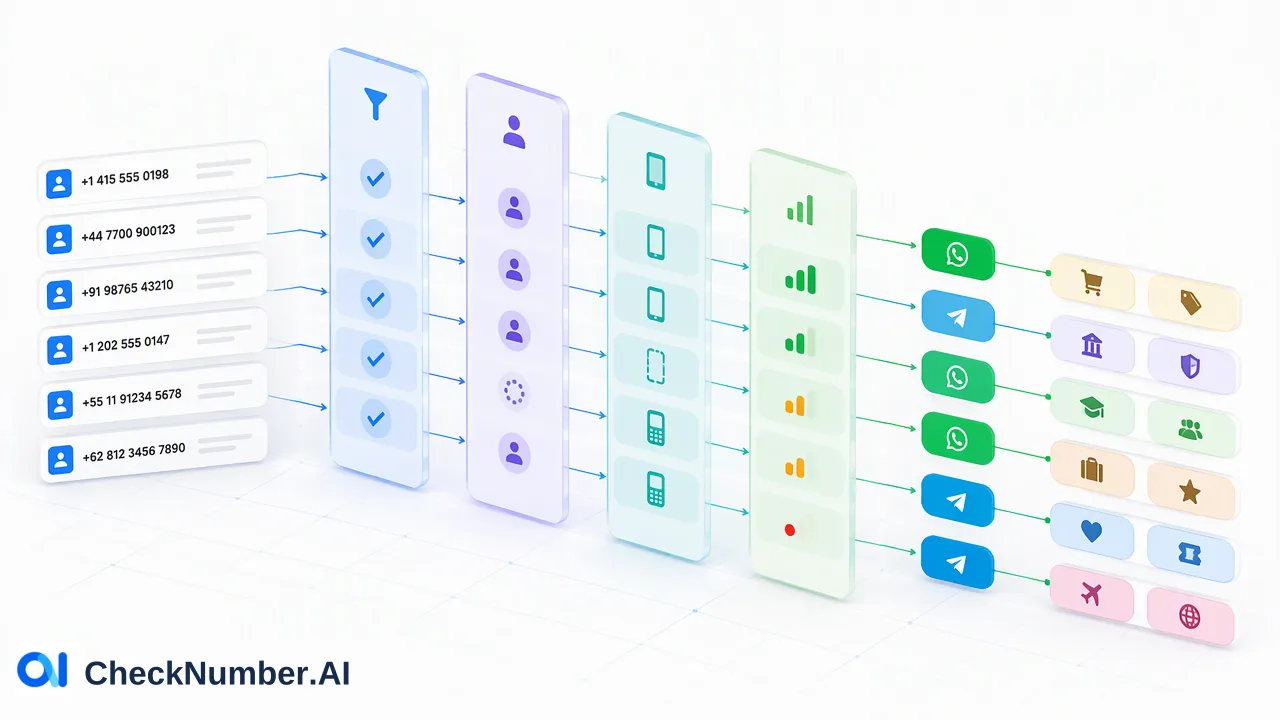
To support more effective outreach, organizations can adopt a multi-layered screening framework that incorporates activity signals, profile enrichment, and regular data hygiene. This approach helps teams prioritize relevant contacts while filtering out stale or low-quality entries from their messaging lists. By moving beyond a simple binary registration status, businesses can use these platform-specific signals as decision-support tools to inform their customer relationship management workflows and allocate messaging resources more efficiently.
The Limitations of Basic Registration Checks
When organizations use tools like the WhatsApp Number Checker, they receive confirmation of whether a specific phone number is associated with an account on the platform. While this is a foundational step for any messaging campaign, it is inherently limited in scope. It is important to distinguish format or normalization checks from platform-registration checks. A format or normalization check verifies that a phone number string adheres to standard numbering plans, such as the E.164 format, without interacting with any external network. A platform-registration signal goes a step further by confirming actual account presence on the specific network. However, even this network-level confirmation does not equate to active engagement. Relying solely on basic registration status can lead to workflow inefficiencies. Teams might send messages to accounts that exist but have been abandoned or are rarely checked by the user. This can skew campaign metrics and consume resources unnecessarily. Therefore, while confirming that an account exists is a necessary baseline, it is insufficient for high-conversion outreach. Organizations need additional context to understand the quality of the account and to support prioritization decisions effectively.
Layering Signals for Better Prioritization
To build a more robust evaluation framework, teams can layer additional data points on top of the basic registration check. Activity signals provide context on account presence and recent usage. For example, the WhatsApp Days Checker provides available activity or last-seen context, alongside available business-account context. These activity signals help organizations gauge the recency of platform engagement, supporting the prioritization of contacts who are more likely to be active on the platform. Additionally, identifying whether a number belongs to a standard user or a business account—using available business-profile signals—can further inform routing decisions. Business-to-business campaigns might prioritize business accounts, while consumer-focused campaigns might filter them out to maintain targeting accuracy. Furthermore, profile and demographic enrichment can assist in audience segmentation. The WhatsApp Age & Gender Checker provides available profile and demographic enrichment data. By incorporating these insights, marketing and sales teams can tailor their messaging to specific segments, improving the relevance of their outreach. Combining registration confirmation with activity and profile signals transforms a flat contact list into a prioritized database. This multi-layered approach helps teams allocate their efforts toward high-value segments rather than treating all registered numbers equally, ultimately supporting more informed campaign management.
Maintaining List Hygiene and Data Freshness
Contact databases degrade over time as users change phone numbers, abandon accounts, or switch messaging platforms. Maintaining list hygiene requires regular screening to keep customer relationship management (CRM) data accurate and actionable. CheckNumber.AI supports this through bulk checking workflows, which help organizations process supported phone-number lists via CSV or TXT uploads, as well as REST API access. For lists requiring higher detection rates, the WhatsApp Advanced Checker provides real-time platform registration signals. Regular bulk checks mitigate the accumulation of stale or unreachable numbers, helping to keep outreach campaigns based on current data. Consistent data cleaning supports more efficient resource allocation, as teams avoid attempting to contact numbers that are no longer registered on the platform. For automated environments, integrating these checks via REST API helps organizations screen numbers programmatically before initiating a messaging sequence. This workflow supports continuous data freshness rather than relying solely on periodic manual uploads. By embedding regular screening into their data management practices, organizations can maintain a high standard of list hygiene, which is a critical component of a comprehensive account quality framework.
Integrating Platform Signals with CRM Strategy
Platform signals should be utilized as decision-support tools for customer-defined review rather than deterministic proofs of campaign success. Integrating these insights into existing CRM workflows helps teams refine their overall targeting strategy. For instance, an organization might route highly active accounts to a priority sales queue while placing newly registered or less active accounts into a longer-term nurturing sequence. By treating CheckNumber.AI bulk checking services as one input alongside internal CRM data, businesses can build a nuanced view of their audience. When a CRM system combines internal purchase history with external activity signals and demographic enrichment, the resulting profile is significantly more actionable. Teams can establish custom thresholds—such as requiring both recent activity and a specific demographic profile—before approving a contact for a high-tier messaging campaign. This integration informs internal decisions regarding message timing, channel selection, and content personalization. Ultimately, moving beyond basic registration checks to a multi-layered evaluation framework supports more intelligent, data-driven outreach strategies that align with organizational goals and improve overall workflow efficiency.
FAQ
Why is a registration check not enough for messaging campaigns?
Relying solely on this binary status can result in resources being spent on abandoned or inactive accounts, which is why additional context is often necessary for prioritization.
What is the difference between a registration signal and an activity signal?
A registration signal indicates whether a phone number is currently associated with a platform account. In contrast, an activity signal provides context on account presence, such as last-seen status or account duration. Activity signals help teams understand the recency of engagement, which supports better prioritization of outreach efforts and informs routing decisions.
How can profile enrichment improve audience segmentation?
Profile enrichment provides available demographic and profile data associated with an account. When organizations use tools that offer demographic enrichment, they can segment their contact lists more granularly. This context helps teams tailor their messaging to specific audiences, informing internal decisions and supporting more relevant, targeted communication strategies.
How can organizations maintain data freshness for large contact lists?
Organizations can maintain data freshness by performing regular bulk checks on their phone-number lists. Using bulk workflows that support CSV or TXT uploads, or REST API access, teams can efficiently screen large databases. Regular data cleaning mitigates the accumulation of stale numbers and helps keep messaging campaigns reliant on accurate, up-to-date reachability signals.
How do format checks differ from platform-registration checks?
A format or normalization check verifies that a phone number string adheres to standard numbering plans, such as the E.164 format, without interacting with any external network. A platform-registration signal checks the specific messaging platform to confirm if an active account exists for that number at the time of the check. Both are useful inputs, but only the latter confirms platform-specific reachability.