CheckNumber.AI
· 6 min read
Exchange Checker: What Phone and Email Registration Signals Can Tell a Team
A scoped guide to preparing exchange-specific list checks and using their signals in a review workflow.
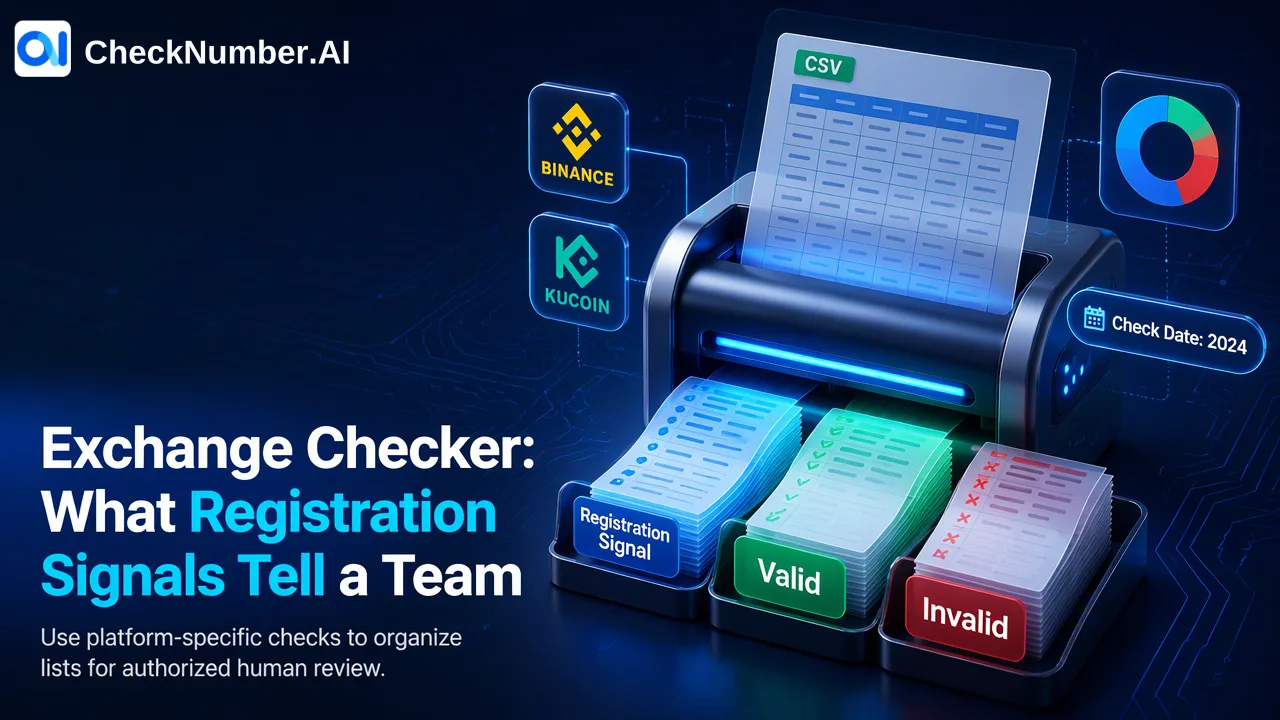
An exchange checker can return a registration signal for a specific exchange and supported phone or email input. Teams can use that signal to organize a list for further review, but it is not evidence of account ownership, KYC status, a balance or trading activity. Choose the named exchange product first, prepare suitable input, and keep the result separate from identity and compliance decisions.
Define the exchange question before selecting a checker
A crypto or fintech team may want to understand whether a contact list has registration signals associated with a particular exchange. That is a narrow question. It does not ask whether the person has passed identity checks, holds assets, trades, or has granted permission for marketing. Write down the named exchange and the input type before choosing a product, because different checks expose different high-level capabilities. A result for one exchange should never be described as registration across all exchanges.
CheckNumber.AI offers platform and exchange registration-signal products within its product directory. Select the product matching the specific exchange and supported phone or email input. If a team needs several named exchanges, plan distinct checks and preserve the product name with each result. Do not combine them into an invented universal status. A contact might have different observations across products, and each observation belongs to its own check date.
A useful planning note states the business question in ordinary language: which records should receive a further, authorized review? This keeps the checker from being promoted into a risk verdict. The FATF virtual-asset red-flag guidance discusses many kinds of information relevant to due diligence and suspicious-activity review. A single registration signal does not supply that broader information.
Prepare phone and email inputs as separate workstreams
Export a working copy of the source list with stable record IDs. Keep each original phone or email value beside the record ID. Decide which exchange product accepts the relevant input rather than assuming one checker accepts both. For phone-list uploads, the documented preparation rule is one country per file and one number per line with the country code; the plus sign is optional. Resolve ambiguous country data before submission. For email lists, preserve the address exactly as collected for later reconciliation.
CheckNumber.AI supports bulk CSV or TXT list uploads and REST API access for supported products. Its free dashboard Number Cleaner can normalize phone numbers to E.164 and remove duplicates and invalid entries before a paid check; Email Cleaner checks syntax and MX records and removes duplicates and disposable addresses. These are preparation tools, not exchange registration results. A cleaned number or email address can still lack the specific exchange signal being sought.
If several customer records share an input value, retain a local map from submitted value to all source IDs. Deduplication of check input should not silently merge CRM contacts. Keep consent and communication preferences per person or account. Especially for marketing use, do not infer permission to contact someone from a platform signal. The list owner must supply its own appropriate authorization and channel policy.
Read each result within its named product scope
After a bulk check, inspect the checker-specific export and document the exact product, input type and observation date. Use the result labels actually provided in that export. Do not publish a guessed field schema, convert every outcome into a binary active-user flag, or assume a result from one exchange explains another. Where the export does not answer a business question, leave that question unresolved.
A registration signal is platform-specific reachability and deliverability information at check time. It does not establish whether an exchange account belongs to the contact in the CRM. It does not show a completed KYC process, a wallet balance, transaction history or current trading behavior. These distinctions matter because a team might otherwise route a record to an inappropriate sales or risk action. Store the registration observation as a separate input to human review.
Treat a negative or unclear observation cautiously. It describes the returned signal for that check, not a permanent statement about the person. Verify that the input was prepared correctly and that the chosen product was the intended one. If the team’s next step requires an identity or compliance conclusion, use its established evidence and review process rather than filling gaps with assumptions.
Build a review queue without overclaiming the data
Create a queue that contains the source record ID, named exchange, submitted input, result, check date and proposed next review. For a marketing team, the next review may be to compare the signal with a separately recorded channel preference and consent status. For an operations team, it may be to investigate a data mismatch. For a risk team, it may be to decide whether other authorized evidence needs examination. These are example internal workflow choices; the checker does not make the decision.
Keep role permissions and record retention within the organization’s own policies. An exchange-related signal may be sensitive in context, so a team should limit access to staff who need it for the stated purpose. Record who reviewed exceptions and what action followed. This audit trail supports later correction if an input was assigned to the wrong contact. It also prevents a registration result from being cited as if it were a verified identity fact.
When planning automation, the API documentation is the place to verify current integration details and applicable limits. This article does not prescribe endpoints, payload fields or response schemas that are not in the trusted product profile. Keep the implementation boundary simple: input preparation, named product check, result reconciliation and separate human decision. The value of an exchange checker is a scoped observation that can inform a workflow, not a shortcut to conclusions the signal cannot support.
FAQ
How can teams use an exchange checker on a phone or email list?
Choose the named exchange product that supports the input, prepare a controlled list, run the relevant bulk check and reconcile the export with source record IDs.
Does an exchange registration signal show KYC status?
No. It is a platform-specific signal at check time and does not establish identity verification, ownership or compliance status.
Can the result show a person’s exchange balance or trades?
No such inference is supported by a registration signal. Balance and trading activity are separate questions requiring their own authorized evidence.
Should every positive result trigger a marketing message?
No. The signal does not establish consent. Teams need their own contact permissions and preferences before outreach.