CheckNumber.AI
· 7 min read
Telegram Number Lookup for Contact Lists: Reading Registration Signals
A list-level workflow for Telegram registration checks and responsible result interpretation.
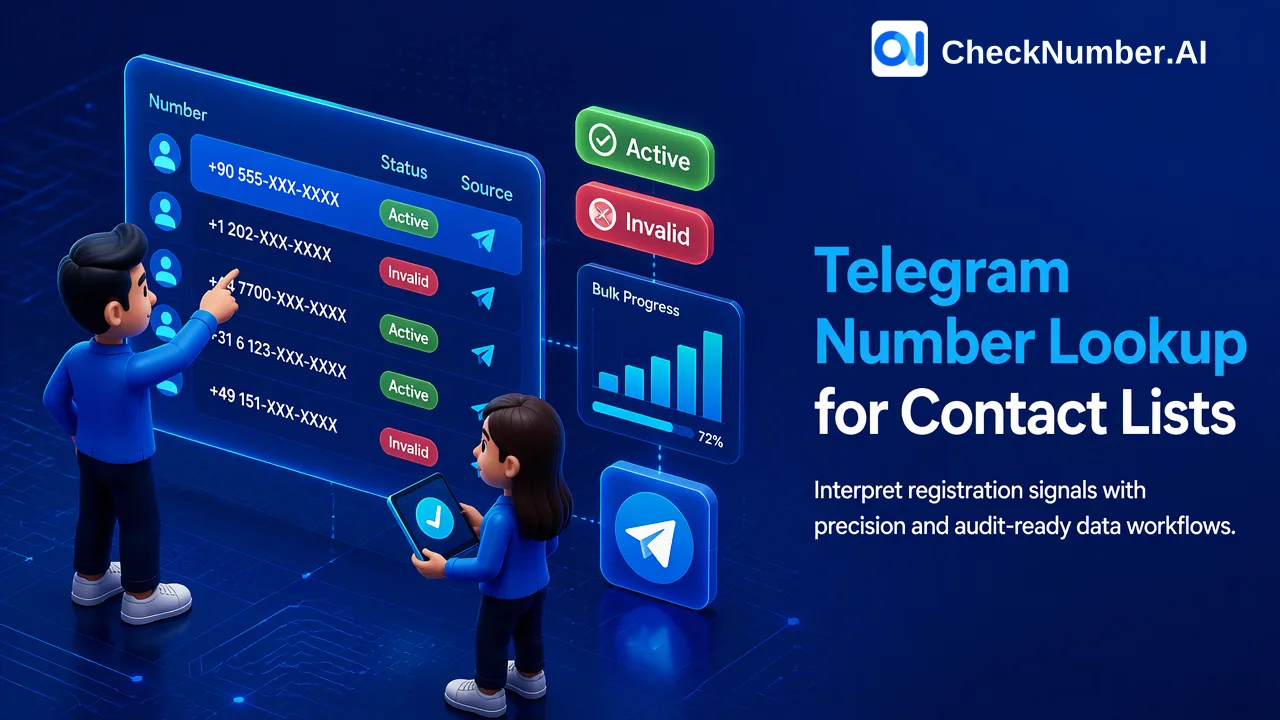
A Telegram number lookup for a contact list checks whether submitted phone numbers return a Telegram registration signal at the time of checking. Prepare country-coded values, run the dedicated Telegram checker through a supported bulk workflow, and reconcile the export with source records. The result is about platform registration, not the person’s identity, ownership of a number, or permission to contact them.
Define the question before starting a Telegram number lookup
A list owner may ask whether numbers are associated with Telegram because a CRM contains several possible contact channels. That question is narrower than searching for a person’s identity. A phone number can change hands, source records can be stale, and the registration signal describes the named platform at check time. Treat it as one observation for segmentation, alongside the organization’s existing consent and source-data records.
Telegram’s FAQ explains that accounts are associated with phone numbers and describes contacts and number changes. It does not turn an external list result into a verified name, an account-holder identity, or a guarantee that a particular person will respond. This distinction matters when a search phrase implies finding a user. A checker result should be recorded under the source phone record, not automatically attributed to a named customer whose relationship to that number has not been confirmed.
There are also different product categories that can be easy to confuse. The basic Telegram number checker concerns a platform registration signal. A dedicated activity product may have a different high-level capability, but that does not make activity a field in a basic registration result. The Telegram number checker page helps a team confirm the named product before submitting a file. State in the job note which product was selected and what question it was meant to answer.
Prepare +90 numbers and other country groups carefully
For a Turkish source list, first establish that the source record is in fact a Turkey number. A Turkish-language form, salesperson, or campaign label is not enough evidence for every row. Keep the original text and source record ID in a local working table. Normalize eligible values into a country-coded representation, then compare the normalized value back to the source before upload. A value that cannot be resolved confidently should enter an exception queue rather than be forced into the +90 group.
If the list includes multiple countries, split it into one country per file. CheckNumber.AI’s documented phone-list upload rule is one number per line with the country code; the plus sign is optional. For an illustrative Turkey-only file, a line begins with +90 followed by the correctly normalized national number. Do not append a PBX extension, a contact name, or a country label to the line. Preserve those details in the team’s local mapping table, where they can be used after checking.
The free dashboard Number Cleaner is documented to normalize phone numbers to E.164 and remove duplicates and invalid entries before a paid check. Use it only for those recorded preparation capabilities. If several CRM records share one normalized number, the team may check the number once while retaining multiple source references. Deduplicating the check input should never silently merge separate people or companies. Keep the untouched extract, the cleaned upload file, and the mapping version distinct so a reviewer can explain each transformation.
Run the dedicated bulk check and preserve the result trail
After preparing the eligible list, use the dedicated Telegram checker through a supported CSV or TXT upload workflow. Supported bulk products also have REST API access, but an integration should follow the current Telegram checker API documentation for exact request details and applicable limits. A general article should not supply guessed endpoints, field names, response structures, or timing assumptions. The documentation describes a Telegram registration check; that is the scope of the result discussed here.
When the checker-specific results are available for export, retain the output with the input file version, check date, selected product, and internal job reference. Reconcile against the source table by the number representation the team preserved, not by assuming the exported rows have the same order as the submitted file. Review missing joins, duplicate source references, and values that changed during normalization. These are customer-controlled review steps; they are not claims about built-in matching or CRM synchronization.
A team can use internal states such as reviewed registration signal, no usable signal, and input needs review. Those labels are examples of its own workflow, not an assertion about the exact output schema. Before updating a CRM, document what each internal state means and which staff member can approve an exception. A check result should remain traceable to one submitted number and one named product. If the source later changes, keep the old observation separate from a fresh check rather than overwriting history without context.
Interpret registration without turning it into identity or intent
A Telegram registration signal is platform-specific reachability and deliverability information at check time. It does not prove that the CRM contact still controls the number, that a particular device is online, that the person prefers Telegram, or that the team has consent to message them. Nor does a basic registration check disclose private conversation content or establish a verified profile. Keeping the scope narrow prevents an operations team from assigning certainty that its source data does not contain.
If a row has no usable signal, begin with the input: country code, transcription, duplicate handling, and the correct product selection. Do not automatically call the number invalid or delete the customer record. A separate phone-number validity product addresses a different question, and its capability should not be borrowed to interpret Telegram registration. An unresolved row can be queued for source-data review, especially where the contact record matters for customer support or account servicing.
For any campaign, bring in the organization’s separately held permission record. A positive registration signal may help choose what to review next, but it is not proof of prior express and informed consent. A suppression list, contact preference, and relevant permission history should govern whether outreach is appropriate. If those records are missing, a positive lookup must not be used as a substitute. This is a decision rule for the organization to adopt, not a promise that the checker makes messaging compliant or effective.
Close with an auditable list decision
A practical handoff contains five pieces: the source extract ID, the normalization and country-splitting rules, the submitted file, the checker-specific export, and a reviewed mapping back to source record IDs. Add a short exception log for ambiguous countries, malformed values, shared numbers, and unmatched results. These details let another team member repeat the list review without relying on a screenshot or a single analyst’s memory.
The useful output is a constrained observation that can inform a channel workflow. It is not a directory of people. When a Turkish-language search brings a team to a Telegram number lookup, that difference is the key to using the result well: prepare true +90 values, preserve source references, use the dedicated registration product, and make any contact decision only after a separate permission review.
FAQ
How can teams prepare a Turkey-only Telegram list?
Confirm each source number’s country, retain its original value and record ID, normalize eligible values with the +90 country code, and put one number on each line in a separate Turkey-only file.
Can a Telegram number lookup identify the person using an account?
No. The dedicated registration result is a platform-specific signal at check time, not verified identity or ownership evidence.
Does a positive registration signal show that the contact is active?
No. Registration and activity are different capability categories. Use only the documented signal of the specific product selected for the job.
How should teams handle numbers without a usable result?
Review the source value, country code, normalization, and selected checker. Keep uncertain rows in a customer-controlled exception queue instead of declaring the contact invalid.