CheckNumber.AI
· 5 min read
Standard vs Advanced WhatsApp Checker: Choosing for a Contact List
Choose the Advanced process when your decision specifically calls for stricter, current registration detection; test both on the same authorized list before adopting either.
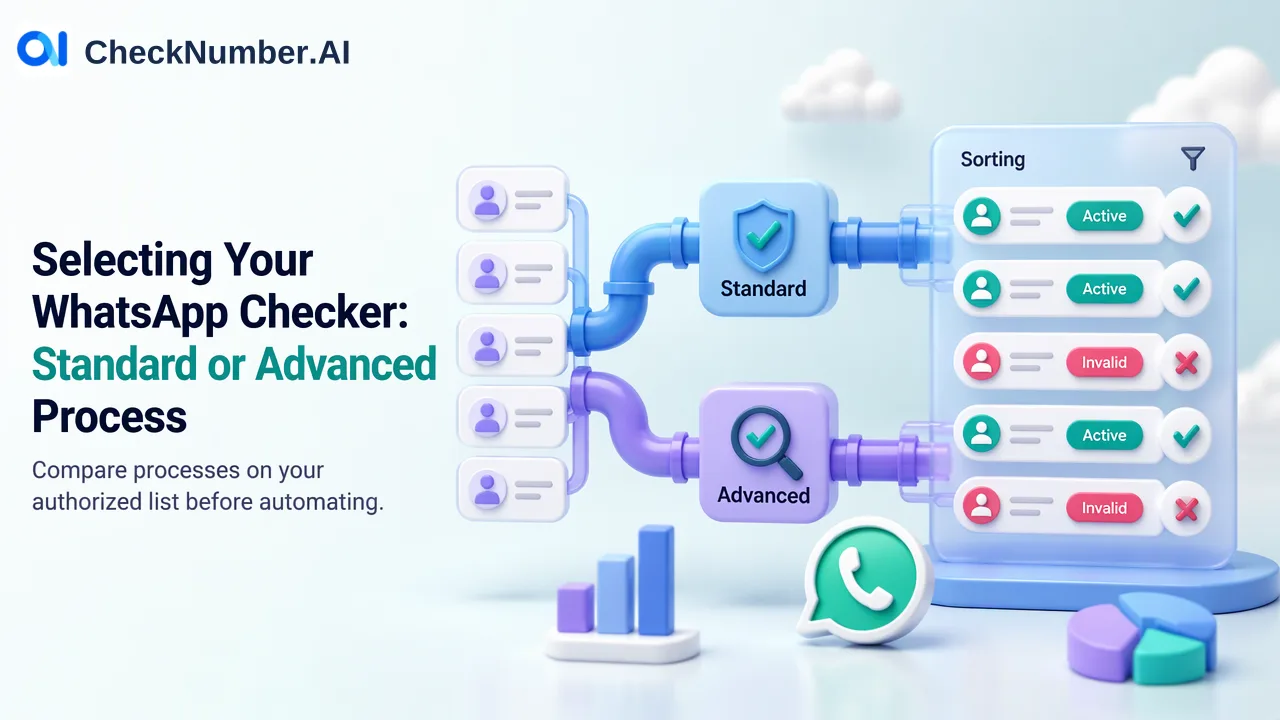
Both CheckNumber WhatsApp products answer whether a supplied phone number has a WhatsApp registration signal at check time. The standard WhatsApp Number Checker is the straightforward registration choice. The WhatsApp Advanced Checker uses a stricter real-time detection process for current registration. Choose Advanced when that process matters to your list-review decision, then compare the two on a representative authorized sample. Neither product, by its registration result alone, establishes recent activity, a person’s identity, consent, or message delivery.
Start with the decision the list must support
A list owner might need to decide which records merit a manual review before a permitted campaign. The first question is whether the team needs a WhatsApp registration observation at all. If so, both named products address that same question for supplied phone numbers. They are separate checking processes, not a progression from a basic identity check to proof of a real person.
The current product profile describes the standard WhatsApp Number Checker as checking whether numbers are registered with WhatsApp. It describes the Advanced Checker as checking current registration through a stricter real-time detection process. That is the documented difference to evaluate. The word “real-time” describes the observation process; it does not promise that a whole uploaded list finishes synchronously or that its result remains permanently true. A registration observation should travel with its check date and product name when an analyst reviews it later.
Before selecting either product, confirm that the selected country’s phone numbers are supported in the current product selector. Do not assume that a generic phone-format check, a WhatsApp registration check, and an activity check cover the same countries or answer the same question.
Use a requirement worksheet, not a tier label
| Team’s actual question | Product to examine | What the result cannot establish |
|---|---|---|
| Is this supplied number associated with WhatsApp at check time? | WhatsApp Number Checker | Identity, consent, recent activity, or delivery |
| Does our review require the stricter real-time process for current WhatsApp registration? | WhatsApp Advanced Checker | Identity, consent, recent activity, or delivery |
| Do we need available last-seen or activity and business-account context? | WhatsApp Days Checker | A guaranteed response or ownership |
| Do we need available profile or demographic enrichment? | WhatsApp Age & Gender Checker | Confirmed personal identity or a usable profile for every row |
The last two rows are different products, not extra columns implied by either standard or Advanced registration. A team seeking activity should specify that requirement before it buys a registration check. Similarly, a profile-related question calls for a named profile product and its documented limits. No registration result substitutes for the team’s own permission record. Recipients need prior express and informed consent for outreach.
A useful selection statement is narrow: “We need a current WhatsApp registration signal for this supported list; we will compare the standard and stricter processes because our review decision depends on their observed differences.” If the decision does not depend on that process difference, standard registration may be the appropriate first candidate. This is a procurement test, not a claim that one process always has higher accuracy or produces better campaign outcomes.
Run a small side-by-side review
Prepare an authorized sample that reflects the list you will actually review. Include the countries and acquisition sources relevant to the intended workflow, plus records that your team already considers straightforward and ambiguous. Keep an independent record of what is known about each sample row; do not label a number as a true WhatsApp account solely because one checker said so. If you lack an independent reference for a row, mark its ground truth unknown.
Run the same cleaned numbers through each selected product close enough in time for a meaningful comparison. Keep the input identifier, selected country, product, run date, and the result as presented in each product’s export. Check the current documentation for upload and access details rather than building a comparison around an assumed response field. CheckNumber supports bulk CSV or TXT list workflows and REST API access for supported bulk products; a team should verify the chosen product’s current route before automating it.
Review the sample in four groups: matching registration observations, differing observations, unavailable or unsupported results, and rows whose reference status is unknown. For a difference, first check that both runs used the same normalized number and country, then record both observation dates and the specific product names. A difference can be an item for investigation without declaring either checker wrong. If a known reference exists, compare each product against that reference only within its scope and time. If no independent reference exists, the comparison shows agreement or disagreement, not accuracy.
Set the acceptance rule before viewing the results. For example, a team may choose Advanced only if the stricter process changes enough relevant review decisions on its representative sample to justify a separate workflow. Another team may find that standard registration answers its question. These are illustrative internal choices, not product performance claims. Document unsupported and unresolved rows explicitly rather than folding them into a positive or negative count.
Record the choice and its limits
The final decision should name the exact signal, the supported list scope, the product used, the observation date, and how uncertain rows will be handled. Recheck the chosen signal when its age no longer fits the team’s decision; no fixed freshness period follows from a registration result. Keep delivery outcomes in the sending system and consent in the team’s own records. This prevents a list-review observation from being presented later as proof of a person, an active conversation, or a successful message.
For the next review, compare the current WhatsApp product information and CheckNumber documentation against the worksheet, then test an authorized representative list using the two registration processes if the stricter process could change your decision.