CheckNumber.AI
· 4 min read
Why Do Two Phone Verification Reports Disagree?
Compare the input, signal and check date before deciding whether two phone verification results truly conflict.
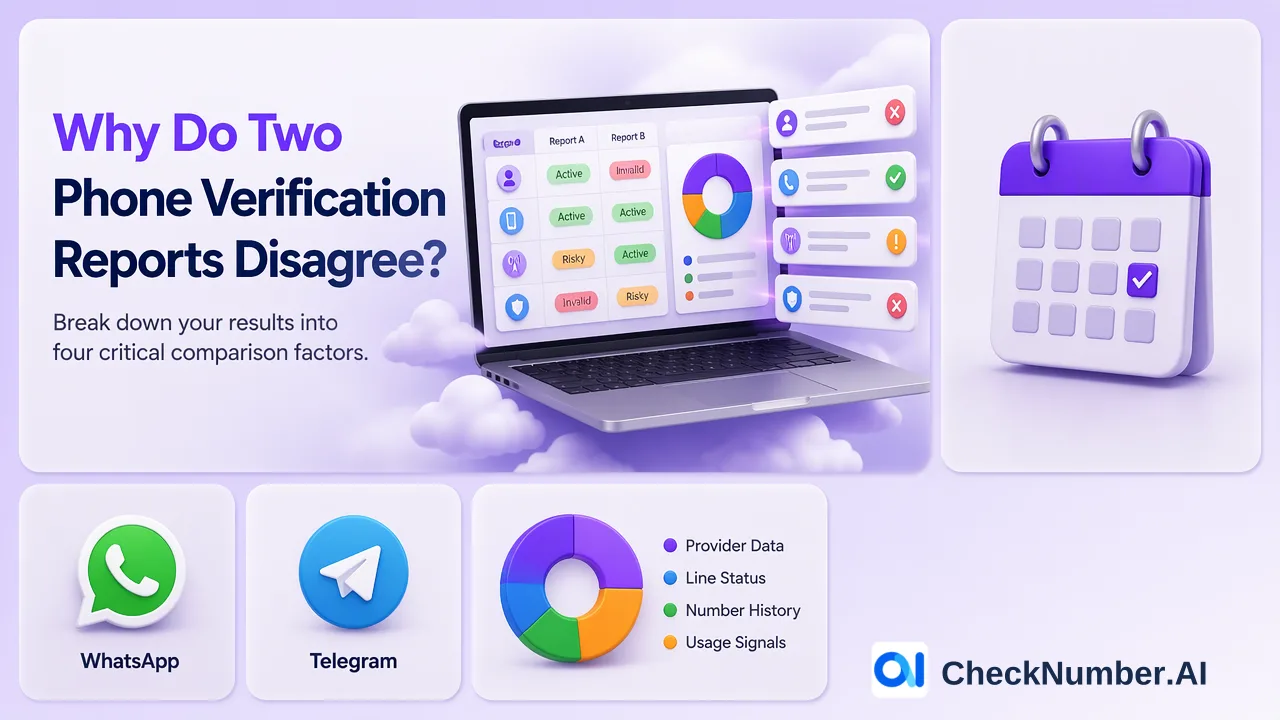
A number marked “valid” in one report and “not registered” in another may have passed two different tests. Before choosing a winner, compare the exact number, country context, selected checker and observation date. Those details tell you whether the reports contradict each other or simply answer different questions. Here is how to work through the comparison without throwing away a useful customer record.
Put the two original rows beside each other
Start with one disputed customer row, rather than comparing the overall success percentages of two files. Bring back the submitted value from each run and your original CRM record. A national-format number interpreted under one country can become a different international number under another. A missing digit, an extension left in the value, or a spreadsheet conversion can also turn an apparent checker disagreement into an input problem.
Keep the original value visible while preparing a normalized working number. Our Number Cleaner helps normalize phone numbers to E.164 and remove duplicates and invalid entries before a paid check. Cleaning is useful preparation; it does not determine which person owns the number. Compare the actual submitted values after preparation, not just the customer name beside them.
Then note the named product and the date for each observation. “Phone check” is too broad to be a reliable column heading. A file called final-results may contain a carrier lookup, a validity observation or a messaging-platform registration check. Find out which one before interpreting its value.
Ask whether both reports measured the same thing
CheckNumber offers separate validity, activity, carrier and platform-registration products. Their observations belong to different questions. A carrier name does not settle WhatsApp registration, and registration does not establish recent activity.
| Pair of observations | What to examine first |
|---|---|
| Number validity and WhatsApp registration | These are separate questions; a different result need not be a conflict |
| Telegram registration and activity context | Presence and available recency information have different meanings |
| Carrier lookup and a messaging check | Preserve both with their product labels |
| Two runs of the same selected check | Compare input, coverage, time and result state |
Suppose your service team sees a usable phone record alongside a negative WhatsApp registration observation. The immediate customer decision is which permitted contact channel to use. Deleting the whole record would discard the phone information because of a platform-specific answer. Keep the WhatsApp observation in its own field and consult the customer’s contact preference before choosing another route.
If both reports do concern the same question, check whether they were collected at the same time. An account can change between observations. A newer result provides a later snapshot, but its date alone does not explain why an earlier report differed.
Use evidence that answers the disputed question
Once you can state the disagreement precisely, choose the next check narrowly. If the question is whether the prepared number shows registration on a named platform today, use the corresponding current registration product. If it concerns carrier information or number validity, choose that service instead. Our product catalogue helps separate those jobs.
Use information you already have as well. A customer’s correction to their number can explain an input mismatch. A recent conversation through an established channel may help your team decide how to contact them, while still being a different observation from a bulk checker result. Record what that evidence actually shows; a CRM name attached to a number does not establish who controls every account associated with it.
An unavailable or undetermined result is not a negative observation. Keep it separate while reviewing the submitted value and the selected product’s scope. Repeating a check can provide another observation, but it may remain unresolved. Avoid turning repeated uncertainty into a confident label merely because a campaign deadline is close.
Leave a useful exception note
A short comparison note is enough to help the next colleague: “Same normalized input; Report A checks validity on Monday; Report B checks WhatsApp registration on Thursday; no direct contradiction; retain both and review the permitted channel.” For a genuine same-question discrepancy, write the two dated observations and the specific question still open.
Keep the disputed row out of decisions that require a settled answer until you have suitable evidence. That does not require removing it from every customer workflow. A support team may continue an existing authorized conversation while a separate list observation remains unresolved.
Take one disputed row from your next export and work through input, product and date in that order. If another check is justified, select the named service in CheckNumber’s phone-checking range rather than rerunning every product.