CheckNumber.AI
· 4 min read
Instagram Email Finder or Account Checker: Which Matches Your Contact List?
The right tool depends on whether your starting point is a profile or an existing, authorized email list.
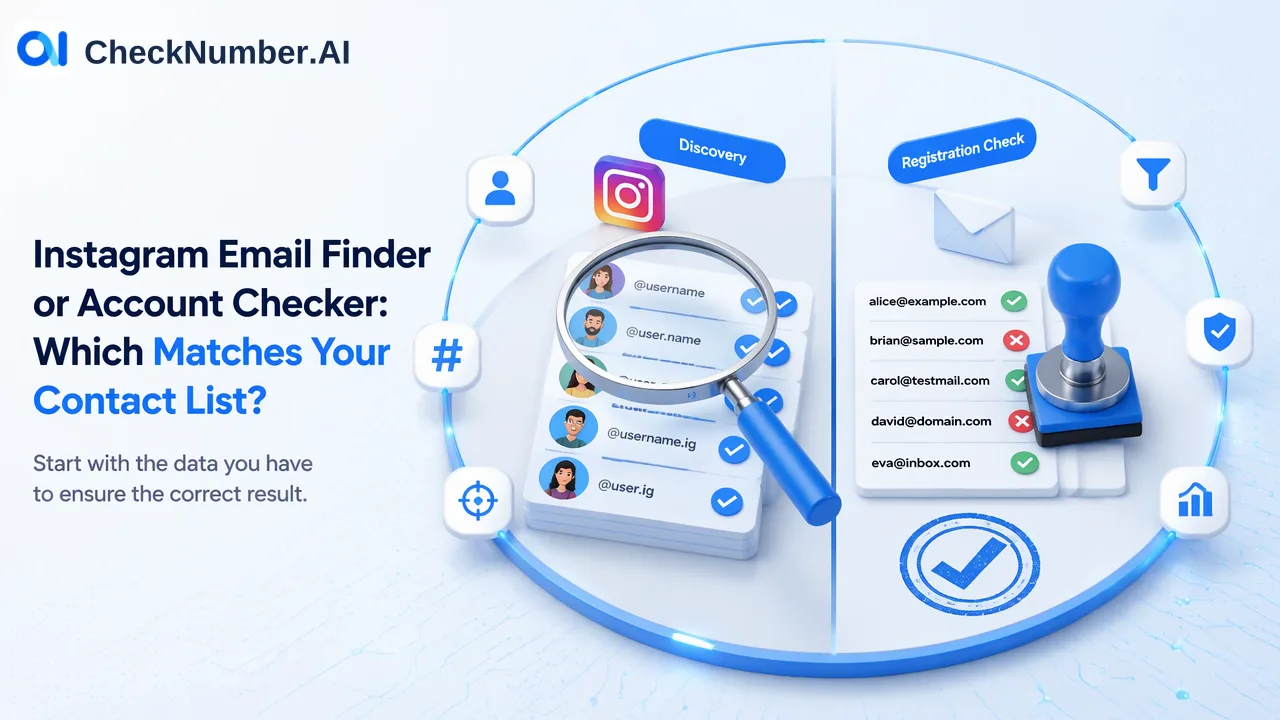
Start with the data you have. An Instagram email finder starts from a profile or username and seeks a public business contact address. An Instagram email account checker starts from an email address you already hold and asks whether that address has an Instagram registration signal. These are different questions, and neither result by itself verifies the person behind the address or grants permission to contact them.
Choose by input and the decision you need to make
A team sometimes searches for an ‘Instagram email checker’ while actually needing a creator’s business contact. An Instagram email finder starts from an Instagram handle and looks for a publicly available business contact. Its task is discovery. If your CRM already contains email addresses, discovery may return a different public address or nothing relevant to the record you need to review.
| Starting material | Question | Suitable route | What remains unanswered |
|---|---|---|---|
| A profile or username, no email address | Is a public contact address available for this profile? | Email finder | Whether any address belongs to the intended owner or is deliverable |
| An existing email address obtained with appropriate permission | Is there an Instagram registration signal for this supplied address? | Email account checker | Mailbox deliverability and permission to contact |
This input test prevents a common purchasing mistake: paying for a profile-discovery workflow when the operating task is to review a known list. The reverse is equally important. If a campaign brief contains only usernames, an account checker cannot manufacture missing addresses. Resolve the acquisition question first.
What CheckNumber’s Instagram Email Checker answers
The Instagram Email Checker documentation describes checking a supplied list of email addresses for an Instagram registration signal through an asynchronous bulk workflow. The question is tied to that named service and the time of the check. It is not a search of Instagram profiles for contact details. It should not be presented as access to private profile information, a recovered password, or an identification service.
A registration observation is also separate from email deliverability. An address may be connected to a platform signal without the mailbox being suitable for email. Conversely, a mailbox that can receive mail does not establish Instagram registration. If your business decision requires both pieces of information, write them as two independent questions and use evidence appropriate to each. Do not relabel one as the other in the CRM.
The result does not establish who currently controls an address or whether a person agreed to marketing contact. Instagram’s own account privacy and contact guidance is platform context; it does not turn a third-party registration observation into permission. Retain the consent basis and source of the email separately from any technical checking result.
A practical review of a list you already hold
Suppose a marketing operations team has an authorized list gathered from its own forms. The immediate decision is whether an Instagram-related registration observation would change a permitted internal segmentation step. First, record the source of each address and remove records without a valid basis for this intended use. Keep a stable row identifier so that the result can be joined back to the original record without treating similar addresses as the same person.
Next, choose the Instagram Email Checker rather than a profile finder, prepare the supported email list according to the current CheckNumber documentation, and run only the permitted sample or list. Review the checker-specific export with the original row IDs, the named signal and the check date. Keep unanswered or unsupported rows separate from negative observations; do not turn missing evidence into a claim that the account does not exist. The docs govern current input and access details, so avoid designing a workflow around assumed fields or limits.
Finally, ask what action the observation can responsibly support. It may inform an internal list review for an already authorized audience. It does not replace a permission record, establish a user identity, or predict ad matching or response. If the team needs to discover business emails from creators’ profiles instead, return to a public-contact finder and evaluate that distinct acquisition task.
Make the next step match the question
Write the intended input and desired answer in one sentence before selecting a tool: ‘We have these permitted email addresses and need a check-time Instagram registration observation,’ or ‘We have these profile names and need public business contact information.’ If the first sentence matches your task, consult the Instagram Email Checker guide and test a small, authorized list. If the second matches, evaluate a finder on its own discovery and permission requirements.