CheckNumber.AI
· 5 min read
After an RCS Support Check: Preparing Your Business Launch
Turn RCS list results into a launch plan: check sender readiness, test SMS fallback, and measure delivery separately.
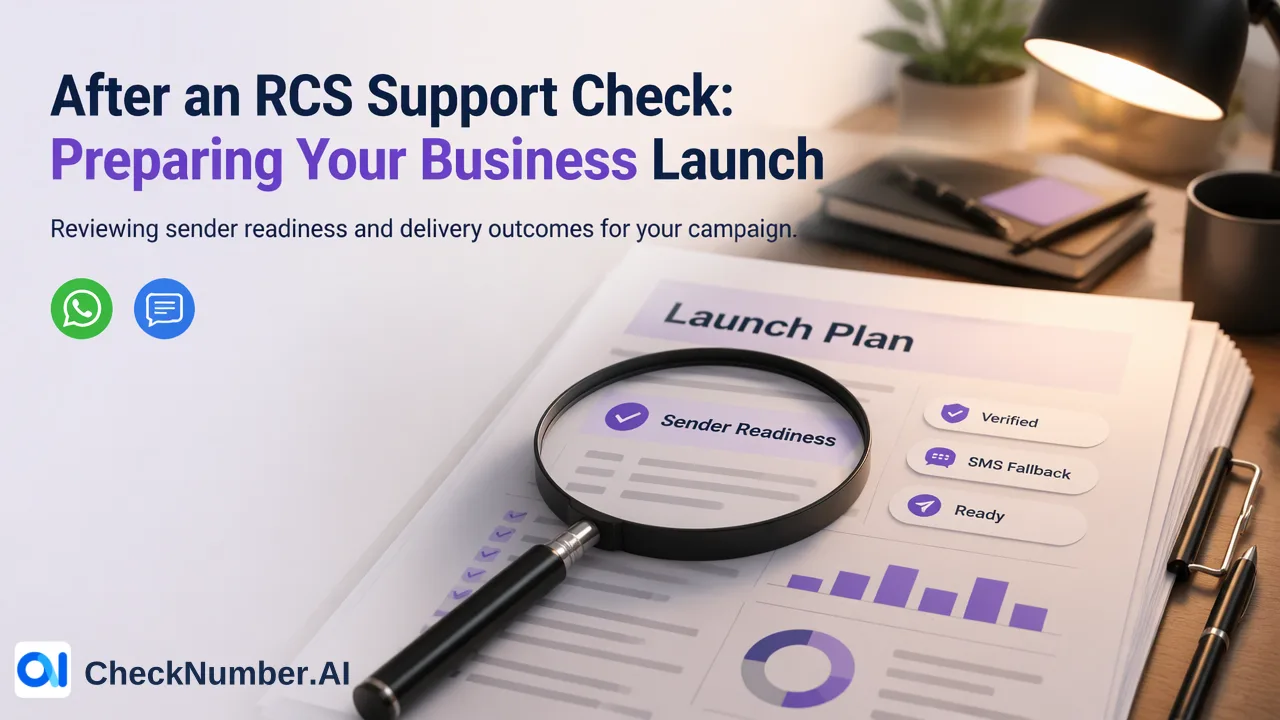
An RCS support check helps you plan which contacts may suit rich messaging. Before launching, verify your own sender’s availability on the intended networks, test the message and its SMS fallback, and collect delivery results from your messaging provider.
Start with the message your customer needs
A delivery update is a useful place to begin. Your customer needs an arrival window and a way to change the delivery instructions. RCS may present those choices as richer content; SMS needs to communicate the essential information in text. The business requirement is the same whichever channel carries it.
Our RCS Checker helps identify numbers with an RCS support signal in an uploaded list. Use that observation to estimate an audience for the rich version and prepare a suitable alternative. Keep the observation date alongside the number so that a later campaign does not silently inherit an old assumption.
Decide which part of the message is essential before arranging a launch test. If the delivery date changes, both versions must convey the new date. A polished rich card does little for a customer who receives an outdated text fallback.
Connect the support file to your actual sender
Support at the number level and readiness of a business sender answer different questions. CheckNumber supplies an observation for planning. Your messaging provider establishes whether your particular agent can serve the intended destination and whether the requested content is supported.
Google’s RCS for Business sending guidance identifies separate failures for unsupported devices, agents that are not launched on a recipient’s network, and message features a device cannot use. A positive list observation therefore leaves a real launch question: can this sender deliver this version of the message through its configured route?
Ask your provider to confirm the agent’s launch status for the markets and networks in scope. Test with the production sender configuration intended for the campaign, rather than assuming a development demonstration proves the same reach. Where a test environment differs, write down that difference before judging the result.
Our checker can include documented system context, but it does not detect the number’s carrier. Obtain network and sender information through the appropriate messaging-provider tools. This gives each decision a usable source without trying to stretch the list export into a sender configuration report.
Make the fallback a complete customer message
Prepare the SMS version while writing the RCS version. Keep the order reference, changed arrival window, and useful next action. Replace any rich interaction with a text alternative your existing customer journey can handle. Review how the message reads on its own; the recipient should not need the missing rich card to understand it.
Fallback also needs a working originator. AWS’s RCS fallback documentation, for example, requires an eligible dedicated phone number or sender ID for the destination; its pool and account configuration determine which identity can be used. Other provider implementations need their own checks. Confirm the equivalent requirements in your chosen service rather than treating “fallback enabled” as the whole setup.
Use test contacts that exercise the important paths: a successful rich message, an unsupported destination, and a temporarily unreachable device where your provider supports a suitable test. Check the visible sender, the text, the destination link, and the eventual delivery outcome. An accepted send request alone cannot tell you whether the customer received a useful message.
Choose what happens to an undelivered update
A delayed promotional message and an expiring delivery update need different treatment. Set a useful lifetime for the customer information, then agree how your sending system handles messages still pending at that point. Google documents message expiration and revocation in connection with fallback; implementation belongs in your messaging stack.
Walk through a late arrival in the test. If SMS has already delivered the revised arrival window, what prevents an older queued RCS update from confusing the customer? Check the provider’s actual expiration, revocation, and event behavior before choosing the timing. Do not infer successful cancellation merely because an application timer fired.
This exercise also clarifies which events your application must retain. Preserve the sending system’s message reference and channel outcome so a later delivery notification can be tied back to the same update. Your team can then investigate a delayed message without rerunning the audience check to answer an unrelated question.
Keep planning observations and delivery outcomes separate
A useful launch handoff contains the checked audience, the check date, confirmed sender coverage, tested message versions, and the chosen fallback behavior. Record which remaining uncertainties require a provider check before expanding the audience.
After launch, measure delivery, failures, expiration and fallback from messaging telemetry. Keep replies and completed customer actions in their own columns. The count of supported numbers is a planning input; the count of delivered delivery updates is an operational result. Showing both lets the team identify whether a problem arose before sending, in a route, or in the message experience.
Start with one complete customer update and its fallback, then carry the same preparation into the next message type. Use the CheckNumber documentation to prepare the support check, and take the resulting audience file into the sender tests that determine your launch readiness.