CheckNumber.AI
· 6 min read
Phone Number Checking API for Latin American Lists
How teams can plan phone number verification api latin america with supported checks and reliable data handling.
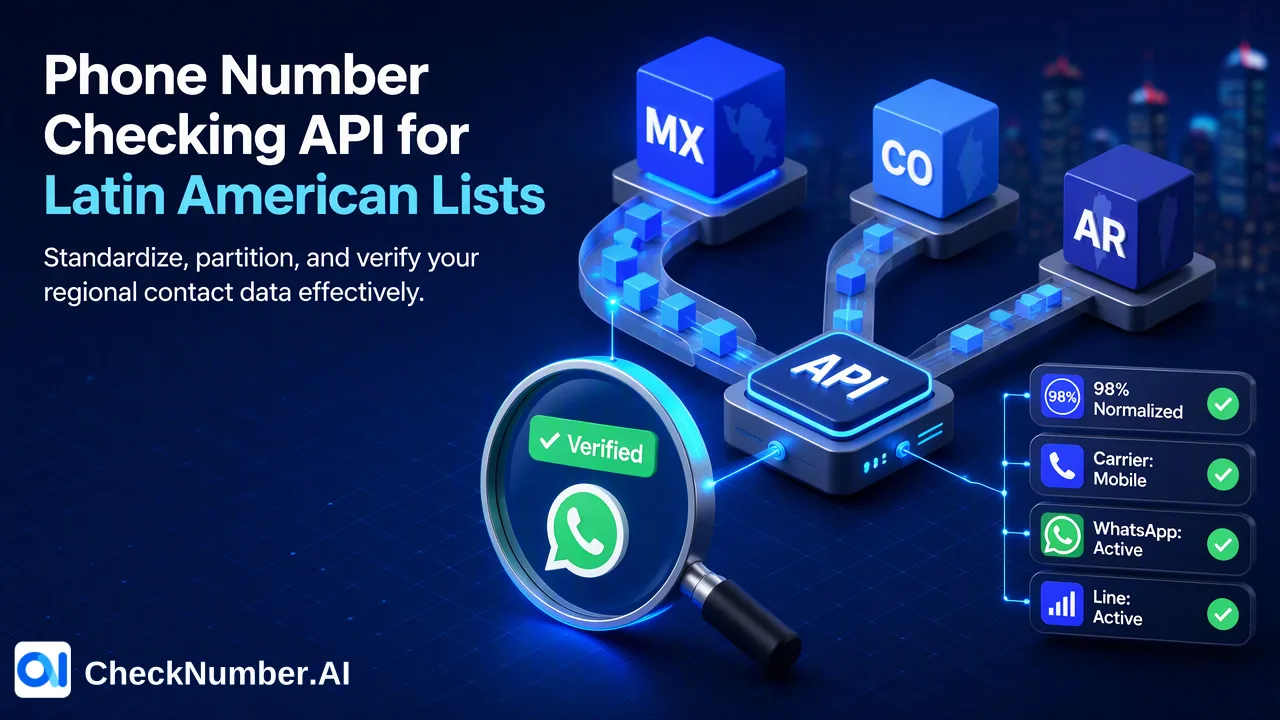
A phone number checking API for Latin American lists should start with clean international numbers and a clearly named question. Split records by country, choose the dedicated validity, carrier, or platform-registration product, and consult its current REST documentation before integrating. The returned signal should inform a customer-controlled decision rather than stand in for identity, consent, or delivery.
Define the decision before selecting an API product
The phrase “phone number verification” hides several different questions. A format check asks whether a number can be represented consistently. A validity check asks for the dedicated product’s documented validity signal. A carrier check supplies carrier, line-type, country, and regional context. A WhatsApp Number Checker addresses registration with that named platform at check time. These answers should be stored in separate fields and interpreted independently.
For a Spanish-speaking development team, the first design document should name the decision that follows each result. If a CRM import needs standardized identifiers, begin with normalization and duplicate removal. If the decision concerns mobile versus fixed line, examine carrier and line-type context. If the question is whether an already-consented contact may be considered for WhatsApp outreach, select the WhatsApp checker. Registration does not establish consent, so the team’s consent system remains the authority for that separate question.
Do not choose one endpoint merely because it has “number” in the name. CheckNumber.AI has dedicated products with different high-level capabilities. The product catalogue helps locate the named checker, while the API documentation defines methods and fields for the selected integration. Do not infer that a field documented for one product appears in another product’s response.
Normalize Mexican, Colombian, Argentine, and other records
Latin American CRM lists often combine local dial strings, country prefixes, punctuation, and numbers copied from spreadsheets. Convert records to E.164 international form only when the country and number can be determined from reliable source data. The ITU recommendation on E.164 defines the international numbering plan; it does not tell a team which country an ambiguous CRM row belongs to. Keep ambiguous entries for review instead of assigning a country from a language preference or sales region.
CheckNumber.AI’s free dashboard Number Cleaner is documented to normalize to E.164 and remove duplicates and invalid entries before a paid check. Cleaning can reveal that two source strings represent the same number. Preserve the original source record identifier and original value in the team’s data store, and keep the normalized value in a separate field. This makes corrections traceable if a country code was assigned incorrectly.
For uploads, the documented phone-list workflow uses one country per file and one number per line with a country code; the plus sign is optional. That rule suggests a useful integration boundary: partition a mixed regional list by confirmed country before requesting checks. Mexico, Colombia, Argentina, and other countries should each have their own file group when using uploads. For any country and checker combination, verify current support in that product’s country selector rather than assuming uniform regional coverage.
Build a documented REST integration
CheckNumber.AI documents REST API access for supported bulk checking products, but a high-level product profile is not an API specification. Before writing a request, read the current documentation for the chosen product’s method, authentication, payload, result fields, and applicable limits. Do not copy example parameters from another checker or invent an error envelope. A test integration should be based on the exact documentation available at implementation time.
A safe architecture can be described without guessing an endpoint: the CRM produces an authorized export; a preparation stage normalizes and partitions numbers; the integration invokes the selected documented product; an export or documented response is reconciled against stable source IDs; customer rules then decide what to do. Keep a queue or staging table on the customer’s side if the team needs human review. This is an internal design choice, not a claim about the product’s processing model.
Use a small authorized sample from each country to verify formatting, country selection, and the join back to CRM records. Check how the team’s parser handles missing or unrecognized values according to actual documentation. Do not silently map an unfamiliar value to “invalid.” Record the product name and check date with the result. If the integration later changes products, rerun the schema review rather than assuming a carrier field and a platform field are interchangeable.
Turn results into bounded workflow decisions
A validity signal can support review of contact data, but it does not guarantee message delivery, response, identity, or ownership. Carrier and line-type context can support channel planning, but it is not platform registration. A WhatsApp registration result is platform-specific at check time. None of those signals authorizes contact. Keep consent status, customer-approved contact channels, and suppression records outside the checker result, then combine them only in the team’s own decision layer.
For example, a customer policy might send a row with uncertain normalization to manual review, use carrier context when considering a mobile-oriented route, and consider WhatsApp registration only for a contact who has already consented to that channel. These are illustrative policy choices. They do not describe mandatory checker behavior or guarantee a communication outcome. Explicitly name the uncertainty category rather than filling it with a confident default.
The regional dimension adds one more review point. If a country is unsupported by the chosen checker, the integration should preserve that fact as an unsupported workflow state rather than claiming that all numbers from that market are negative. If a source row lacks enough information to choose a country, request correction from the source system. That distinction prevents the resulting CRM segment from confusing unavailable data with an actual checker signal.
FAQ
How can developers choose the right checker for a Latin American list?
Define whether the decision needs validity, carrier and line type, or registration on a named platform. Select the dedicated product and confirm country support.
Should a mixed-country list be sent as one upload?
No. The documented phone upload format uses one country per file. Partition by confirmed country and retain stable source identifiers.
Can teams infer API fields from a product summary?
No. Use the current API documentation for methods, fields, authentication, and applicable limits.
Does a positive platform result authorize outreach?
No. Registration and prior express and informed consent are separate records and decisions.