CheckNumber.AI
· 7 min read
VK Number Checker: Checking a Phone List for VKontakte Registration
A practical bulk-list workflow for interpreting VKontakte registration signals without treating them as a complete contact profile.
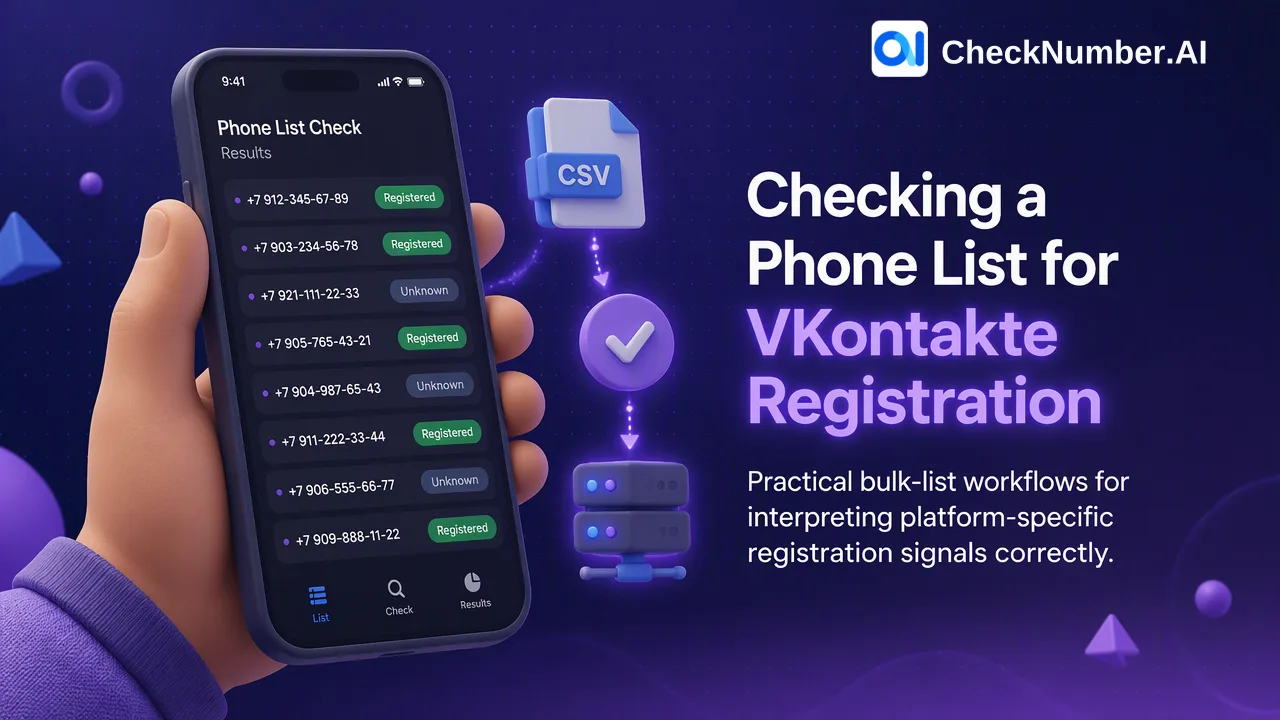
A VK number checker helps a team see whether phone numbers in a prepared list show VKontakte registration at the time of checking. Normalize the numbers, separate country-specific inputs, run the dedicated VKontakte Checker, and reconcile the exported observations with the team’s source records. Use those observations for channel planning only after applying the team’s own permission and suppression rules.
What a VK number checker actually tells a team
The relevant question for a social-media planning team is narrow: which numbers in a list show a registration signal for VKontakte? CheckNumber.AI describes its dedicated VK checker as a way to inspect that platform-specific association in bulk. The VK product documentation describes a phone-number input and a registration result for the selected platform. It does not turn the export into a general directory of people or their social behavior.
A registration observation is useful because the contact list may contain people with different channel histories. A team may want to review which consented contacts are candidates for a VK-oriented channel plan, which require another contact path, and which need manual checking because their source data is incomplete. The checker provides one input to that planning process. A positive observation says something about the named platform at check time. It does not supply an outreach permission, an account profile, or a measure of how frequently someone uses VK.
The distinction matters when results are moved into a CRM. A field named “VK registration observation” with its check date communicates the scope of the evidence. A field named “verified VK customer” would add unsupported meaning. Teams can preserve the useful information without giving the signal a broader interpretation than the product documents.
Prepare Russian and other country lists carefully
Export the records that the team is authorized to analyze, retaining a stable internal record ID in a customer-controlled working file. Identify the declared country for each phone number before formatting it. A number written in a local style may be missing the information needed to assign a country code reliably. Do not guess from a contact’s language, name, or market segment. Set uncertain rows aside for source-record review.
The product’s general phone-list workflow uses one country per uploaded file and one number per line with its country code; the plus sign is optional. For a Russian-country list, reviewers should look for correctly assigned +7 international numbers. A shared calling code does not justify treating every +7 row as belonging to the same country. Review country metadata for each input group before submission. If the team also has contacts from other countries, verify the chosen product’s current country support rather than assuming that a VK audience label establishes checker coverage for every market.
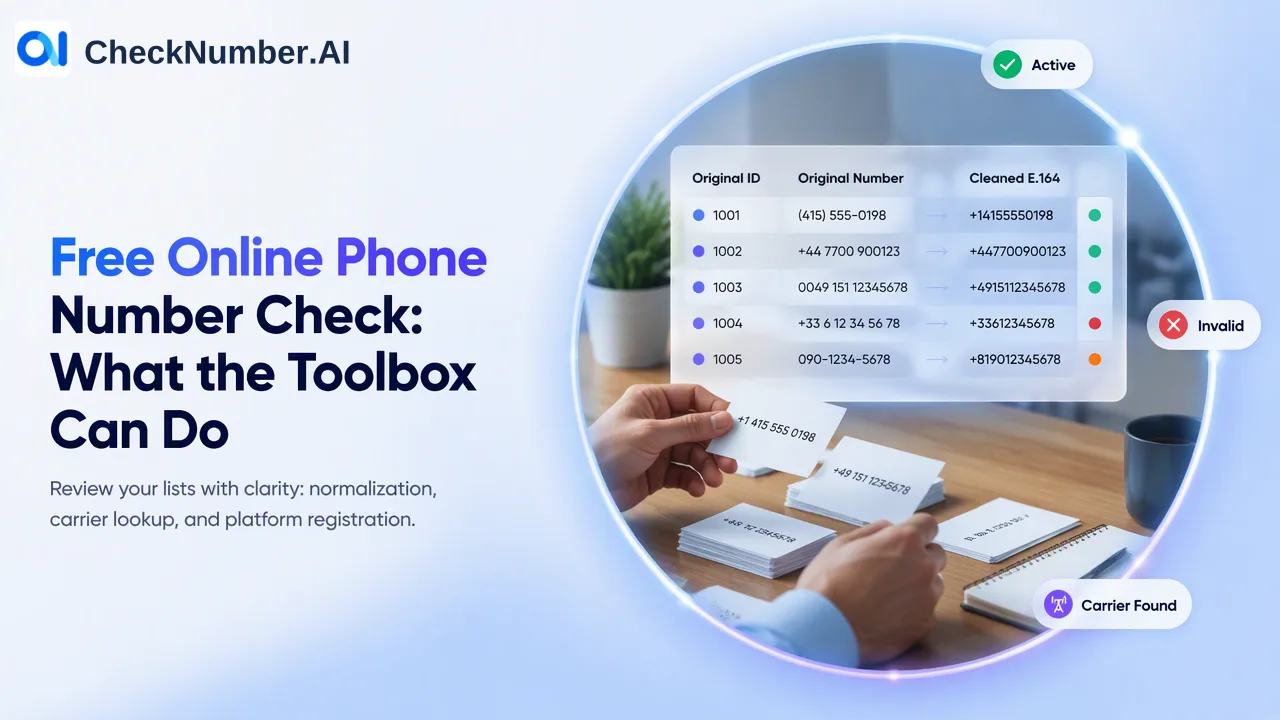
Use the documented Number Cleaner to normalize numbers to E.164 and remove duplicates and invalid entries before a dedicated check. Keep a separate mapping from the original CRM record to the normalized number. When several CRM records map to the same normalized value, the team can later apply one observed result to the relevant records while still preserving the separate consent and relationship history of each record. CSV or TXT can be used in the supported bulk list workflow; review the prepared file visually before uploading it.
Run the VKontakte check and reconcile the export
Choose the VKontakte Checker rather than a generic validity or carrier product. The task is to inspect VK registration, so another product’s output would answer a different question. Submit the cleaned country-specific list through the supported bulk upload workflow. Teams with a recurring workflow can consult the current API documentation for the exact VK integration contract rather than copying an example from a different checker. The documented REST API route is an option for supported bulk products, but implementation details should come from the current documentation.
After the result is available, export it and match rows to the source working file by normalized number and the team’s own record reference. Record the time of the check in the customer-controlled review table. Preserve rows that do not reconcile cleanly in an exception group, including duplicates with conflicting CRM metadata and numbers whose country assignment was uncertain. Do not silently drop those contacts or turn missing observations into negative ones.
A useful review sheet can include the source record ID, original number, normalized number, declared country, check date, VK observation, and team disposition. Those are suggested customer-side analysis columns, not a claim about a universal export schema. Separating the observed signal from a team decision makes the process easier to explain and revise.
Use registration signals for a responsible channel plan
The result may help a team prioritize a VK-specific review of its existing audience. For instance, a team might classify records with a positive VK observation as candidates for a VK channel plan and route other records through a separate channel-selection review. That classification is a customer-defined example, not an automated action by the checker. It should be applied only to records for which the organization already has an appropriate basis for the intended outreach.
Registration is not consent. Prior express and informed consent for outreach must be established from the team’s own records, together with applicable suppression decisions. A registration observation also does not identify the person controlling an account. In a shared or reassigned-number situation, a phone-based signal should not be treated as a permanent identity link. The practical action is to keep a signal in its own field and let documented contact permissions govern any campaign.
The result is not an activity metric. If the team’s question is whether an account is active, how recently it was used, or what an account holder prefers, this checker’s high-level registration capability does not answer it. A channel plan can still benefit from the narrow observation: it can avoid treating an entire phone list as equally likely to fit one platform, while keeping outreach decisions under human and organizational control.
Keep the result useful as the list changes
A list check is a dated snapshot. CRM records may be corrected, numbers may be reassigned, and a later campaign may contain contacts who were not in the original extract. Before a new campaign, compare the intended audience to the checked snapshot. Recheck or review newly added and materially changed records according to the organization’s own policy. There is no universal freshness period implied by a registration result.
Document the important handoffs: which source list was extracted, how country groups were formed, what normalization removed, which checker was selected, and how results were reconciled. Keep the original export and the prepared input separate. A reviewer can then distinguish a genuine observation from a source-data mistake or a policy decision.
For Russian-speaking audiences in particular, avoid converting language into a technical assumption. A person who speaks Russian may have a number registered under another country, and a +7 number alone does not provide a complete audience profile. Use verified source country data, the product’s current coverage, and a dated platform observation. That combination answers the operational question more clearly than a broad claim that a list contains “VK users.”
FAQ
How can teams check VK registration across a contact list?
Prepare a country-specific file of normalized international numbers, run the dedicated VKontakte Checker through the supported bulk workflow, and export the observations. Reconcile each number against a customer-controlled source record and retain the check date.
How should teams handle a number with an uncertain country?
Set it aside for source-record review rather than guessing a country code from language or audience segment. Submit only numbers whose intended country grouping and format have been checked.
How can a VK signal inform a channel plan?
Treat it as one dated, platform-specific input. A team may create a VK candidate review group, then apply its own consent, suppression, and campaign rules before deciding whether any contact should be approached.
What should a team do when exported rows do not match the CRM?
Preserve the unmatched rows in an exception group and examine normalization, duplicates, and source identifiers. Do not automatically interpret an unmatched row as a negative VK result.