CheckNumber.AI
· 6 min read
Phone Number Extensions and Bulk Validation: Keep the Base Number Separate
Learn to separate PBX extensions from base numbers, retain a local mapping, and review bulk check results without losing contact context.
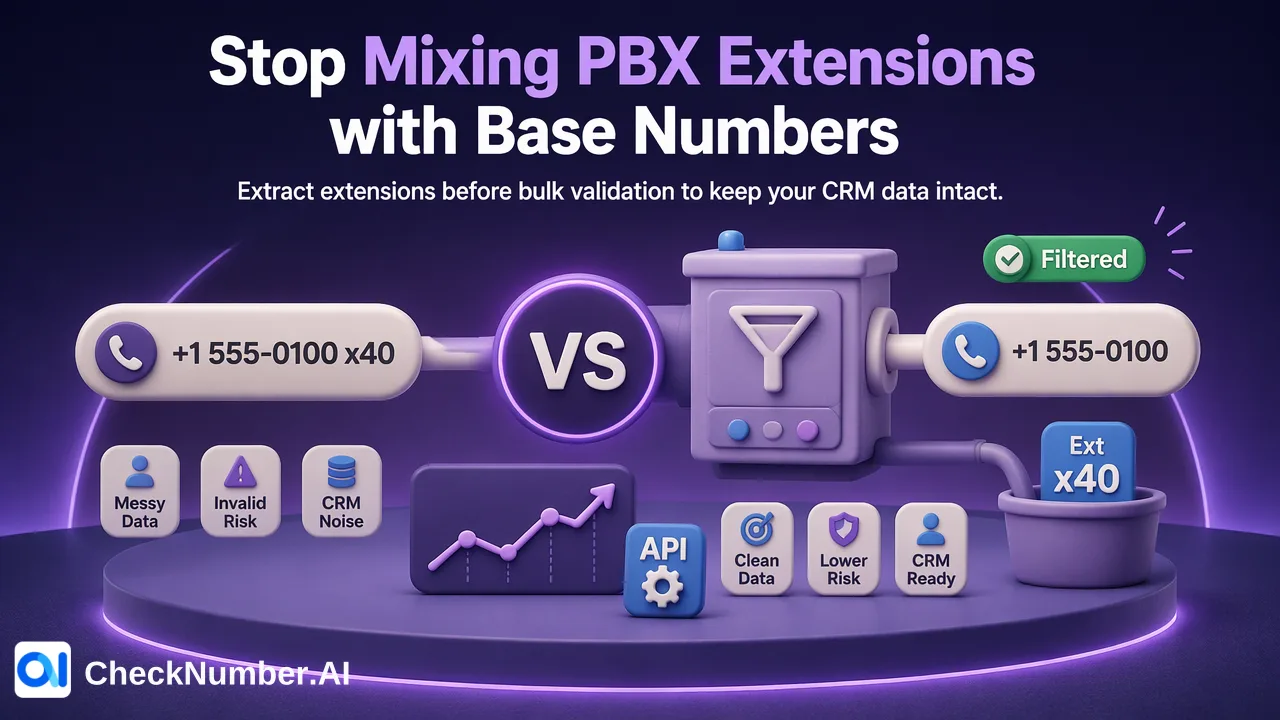
A phone number extension should be separated from the base number before bulk validation. Keep the extension in a local mapping tied to the original contact, prepare only the internationally formatted base number for the phone check, and join the result back afterward. This preserves routing information without mistaking internal PBX digits for part of the public number.
Why phone number extensions complicate bulk validation
An extension identifies a destination inside an organization’s phone system. It is meaningful after a call reaches the organization’s main number, but it is not an extra piece of the internationally assigned subscriber number. The ITU E.164 recommendation describes the international numbering structure; an internal desk extension belongs to a different routing layer. When a spreadsheet cell contains a base number followed by ext 204, x204, or a similar label, the combined cell is not a clean phone-number input. A bulk checker can evaluate the base number only after the team has decided which part is the actual public number.
This matters because a contact export may contain a working office line and a valid extension in one field. Treating the whole string as a failed phone number can wrongly discard a usable contact route. Stripping the extension with no record of it creates the opposite problem: the check result may look acceptable, while the sales or support team can no longer reach the intended person. The useful output is therefore two linked artifacts: a number-only check file and a protected mapping that retains the original field, extension, and source record ID.
Create a base-number file and an extension map
Start with a copy of the source export. Give every source row a stable internal record ID before changing any phone field. Keep that ID even if two contacts share the same office switchboard number. In a separate working table, store the original phone text, the interpreted base number, the extension text, the country context used to interpret the base, and a review status. This table is managed by your team; it is not a field that CheckNumber.AI promises to create or return.
Parse only extension patterns that your source system actually uses. For instance, ext. 204 may be unambiguous in one dataset, while a bare trailing 204 could be part of the number in another. Put uncertain rows into manual review instead of removing digits on a guess. Preserve punctuation in the original field for audit, but normalize the check input to the base number with country code. CheckNumber.AI’s Number Checker accepts bulk phone-number input, and the documented list workflow uses one country per file and one number per line with the country code; the plus sign is optional. Keep countries in separate upload files when an export spans several countries.
A practical local mapping might contain record_id, original_phone, base_number, extension, and review_note. These column names are a suggested internal data design, not an API schema or product output. If the same base appears in several rows, maintain all of its source IDs. Deduplicating the check input is reasonable, but deduplicating away the source relationships is not.
Validate the prepared file before submitting it
Count source rows, parsed rows, and review rows separately. A parser that produces one check input for every source field can still be wrong if it silently appends extensions to numbers. Inspect representative patterns from each export source: switchboard numbers, direct lines, numbers with # markers, empty extensions, multiple phone fields, and international formats. Compare the prepared number against the original, not just against the parser’s own output.
Check that each prepared line contains one base number and no extension label, whitespace comment, contact name, or spreadsheet formula. Confirm that the country code is present and that the file belongs to a single country. A format cleanup step can help normalize phone text, but the team must still verify ambiguous splits. The goal is to make the input reflect an actual public number, not to force every source cell into a plausible-looking shape. Keep a separate exception queue for cells that cannot be resolved from source evidence.
Join the check result back without losing the extension
After the bulk check, use the returned checked number as a matching key only after normalizing it in the same way as the local base-number column. Do not assume result row order matches upload row order. If one base number belongs to several contacts, apply the number-level result to the relevant local mappings while leaving each contact record and extension distinct. A number-level validity or activity signal does not establish that a specific extension is still assigned to the person named in the CRM.
Record the check date and the product chosen. A base-number result can inform whether the public number merits further review, but it cannot verify the internal extension or guarantee a call will reach a desk. For unresolved or conflicting joins, hold the CRM update and ask the contact owner to review. Teams choosing a suitable number-level signal can review the Number Checker product; the particular decision to keep or retire an extension remains in their own contact-management workflow.
A review checklist before updating the CRM
Before making any CRM change, verify five questions. Was the extension explicitly identified rather than guessed? Is the base number stored with the correct country context? Does every checked base number map back to every relevant source record? Are uncertain or unmatched results held for review? Has the extension remained available to the team that needs to route a call?
A passed phone check is one input to a data-quality decision, not proof that a named employee still works at that extension. If a company has changed its switchboard, the contact record may need a human update even where the base number appears usable. Keep the raw export and the mapping for an appropriate retention period under the team’s own policy, restrict access to personal contact data, and make CRM changes reversible. That combination makes the check useful without destroying the very routing detail that motivated the cleanup.
FAQ
How can teams check a list containing PBX extensions?
Create a local mapping of source ID, base number, and extension; submit only the country-coded base numbers in the supported bulk file format. Rejoin results to the mapping afterward.
Can a successful base-number check confirm an extension?
No. The product checks a phone-number signal for the base number. The internal extension and its current assignment require separate review by the organization.
How should shared switchboard numbers be handled?
Check the unique public number if appropriate, but retain every contact-to-extension relationship in the local map. One result may relate to several distinct records.
What should happen to ambiguous extension patterns?
Leave the original text unchanged in the source copy and place the row in manual review. Do not infer that trailing digits are an extension without source context.