CheckNumber.AI
· 4 min read
Two CRM contacts share a phone number. Should you merge them?
Review shared phone numbers before merging CRM records. Preserve extensions, customer relationships and communication preferences in a reversible cleanup.
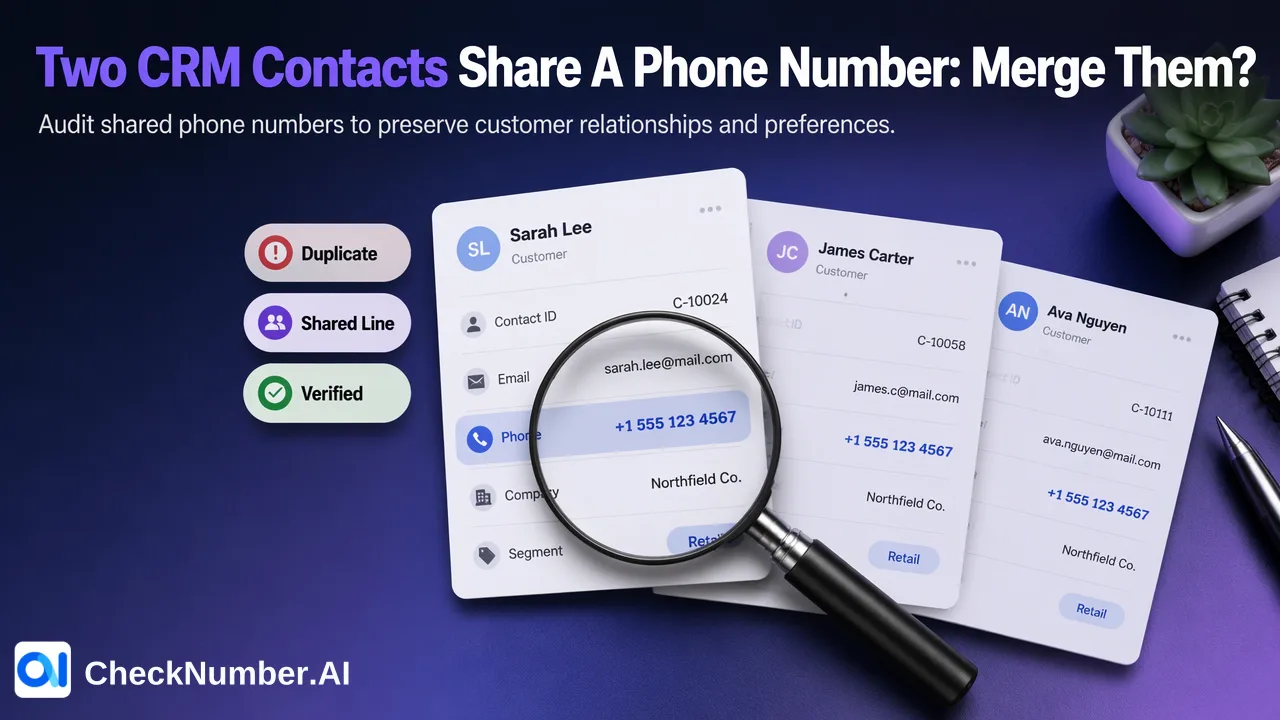
A CRM cleanup can turn three different strings into the same phone number. That is a good reason to review three records together. It is a poor reason to erase two of them. The decision depends on what each record represents and what would disappear in a merge.
Start with the records behind the number
Imagine a distributor with two customers at the same hotel. One buys kitchen supplies and the other orders linens. Both gave the reception desk as their daytime contact. Once the country code and formatting are consistent, those numbers match perfectly. Merging the people would move two buying histories under one name. Keeping two contacts linked to one shared business line preserves the useful fact the cleanup uncovered.
Compare that with two imports of the same customer record. Both carry the same stable customer ID from the same source system, the same account relationship and the same contact role. One import has spaces around the phone number. Here the customer ID supplies evidence for the merge. Phone cleanup simply helped bring the pair to the reviewer’s attention.
Give the reviewer enough evidence to decide
Keep the original row ID, source system, original phone field and cleaned value together. Preserve extensions separately. A switchboard with extension 214 reaches a different desk from the same switchboard with extension 307. If the original country context is missing and two interpretations are plausible, leave the row unresolved until the source owner can supply that context.
Group records by cleaned number and inspect each group. For an exact repeat of the same source record, retain the surviving CRM ID and a reference to the retired row. For several people sharing a business line, preserve each person and record the shared number on the organization or on each relevant contact according to your CRM model. For a conflict you cannot explain, keep both records and assign the question to the person who owns the source data.
Test what a merge would change
Before saving, preview the surviving contact, assigned owner, open cases and communication preferences. A recent opt-out can sit on the older row. A blank permission field on a newer import supplies no basis for overwriting that restriction. If the CRM cannot preserve the required restriction or relationship during a merge, leave the records separate.
Try the rule on a small batch that includes headquarters lines, extensions, apparent duplicates and records with missing country information. Count records reviewed, confirmed duplicates, shared numbers and unresolved groups. A low merge count can be the correct outcome for a list of branch offices. A high merge count deserves a closer look if the source contains many shared service desks.
Keep a reversible handoff
For every approved merge, record the original IDs, surviving ID, evidence, reviewer and date. Keep a pre-merge export according to your retention policy. After applying the batch, reopen a shared-number example and a confirmed duplicate. Check that staff can still find the right customer, see the right history and respect the recorded preferences.
Use CheckNumber’s Number Cleaner during preparation. Let the CRM evidence and the reviewer decide whether two customer records belong together.
Audit the exceptions after the first import
Select one group that the reviewer merged and one that the reviewer deliberately kept separate. Ask a colleague who did not perform the cleanup to reconstruct both decisions from the saved evidence. Can they find the original extension? Can they identify the customer record that owns the service case? If they need to ask the reviewer what a column means, fix the handoff before increasing the batch size.
A useful exception register is short. Give each unresolved group an owner, a reason and a next action. For two branches sharing a reception line, the owner might ask the account manager for the local extensions. For a duplicated contact ID imported from two systems, the next action might be checking which system issued the ID. Close the exception when the missing evidence arrives, and record the date. A phone number that remains shared after review is a successful resolution when both relationships have been preserved.