CheckNumber.AI
 · 4 min read
Optimizing LINE Outreach: A Data-Driven Framework for Thai Market Success
Optimize LINE outreach in Thailand by adopting contact list hygiene, platform registration checks, profile enrichment, and audience segmentation.

Effective LINE outreach in Thailand requires shifting focus away from unverified list volume toward rigorous LINE contact list hygiene and segmentation. Rather than treating contact databases as monolithic rosters, marketing and operations teams achieve better resource allocation by verifying platform-specific account presence at check time, removing invalid entries prior to dispatch, and utilizing demographic and profile enrichment to inform segmented communication strategies.
The Strategic Shift from List Volume to Audience Quality
In digital marketing environments where messaging fees and operational resources scale with dispatch volume, managing outreach through top-line record counts creates operational friction. High-volume databases frequently aggregate outdated entries, unformatted records, and numbers that have never registered on messaging applications. When organizations prioritize raw volume over data verification, outbound efforts result in undeliverable messages, inaccurate response rate calculations, and wasted campaign expenditure. A quality-first framework replaces vanity metrics with verified reachability. In the context of Thailand, where LINE serves as a central hub for commercial communication, evaluating audience quality requires examining whether individual records correspond to active platform profiles. By confirming platform presence prior to campaign deployment, teams align operational costs directly with reachable prospects rather than unverified datasets.
Establishing Pre-Send Contact List Hygiene
Data hygiene serves as the baseline requirement for scalable messaging workflows. Before any outbound messaging initiative begins, records must undergo pre-send validation to eliminate basic structural errors, duplicate values, and inactive numbers. A comprehensive hygiene workflow addresses multiple phases of data management:
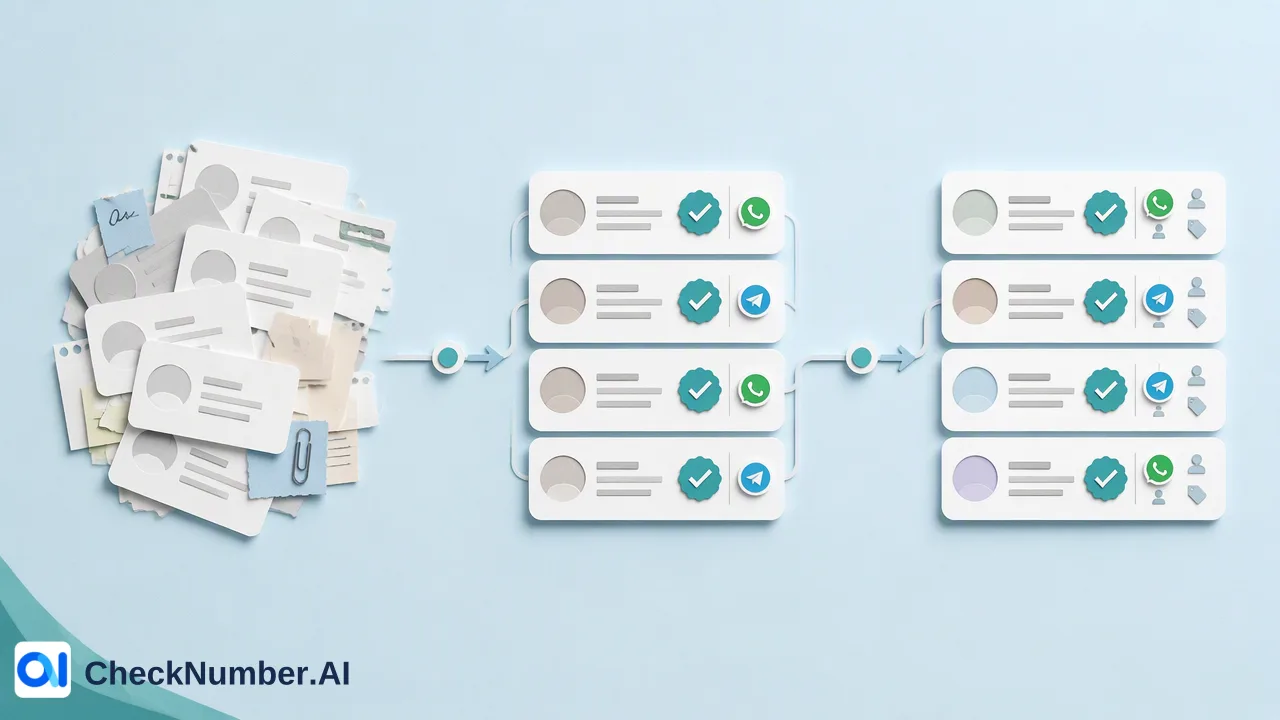
- Syntax and Normalization: Checking that numbers conform to standard international dialing structures, such as E.164 country codes, avoiding misrouting caused by inconsistent regional entry patterns. * Deduplication: Merging or removing recurring entries across multiple lead-capture forms, preventing prospects from receiving redundant outbound communications. * Reachability Verification: Evaluating whether a target number maintains an account presence on LINE at check time. Maintaining database health is not a one-time project. User behavior shifts continuously as consumers migrate between devices, change telecommunications providers, or abandon unmonitored accounts. Executing hygiene routines cyclically prevents database decay, supports CRM accuracy, and maintains a clean foundation for segmentation.
Applying Platform Registration Signals and Enrichment
Beyond generic format checks, optimizing LINE outreach depends on platform-specific intelligence. Generic validation tools can confirm whether a telephone number matches an assigned carrier format, but they cannot indicate whether that subscriber utilizes LINE. Organizations can incorporate specialized verification inputs into their pipelines through bulk list checks via CSV or TXT uploads, or through direct REST API integration:
| Verification Input | Documented Signal Scope | Primary Operational Role |
|---|---|---|
| Line Checker | Platform registration signal confirming account presence | Filters unreachable records out of outreach pipelines at check time |
| Line Profile Checker | Platform registration signal plus available profile and demographic enrichment | Informs targeted audience segmentation and campaign personalization |
| A platform registration signal provides reachability context at the specific moment of verification. When paired with demographic enrichment, teams can append available contextual details to customer records, establishing clear segmentation boundaries before drafting campaign collateral. |
Structuring Segmented, Localized Outreach in Thailand
Once invalid entries are purged and verified profiles are identified, outreach strategies can be segmented according to regional, behavioral, and demographic criteria. Monolithic broadcasts in Thailand often yield low response rates because consumer preferences vary significantly across geographic areas, demographic cohorts, and interaction histories. Structured segmentation allows teams to tailor communication parameters effectively:
- Regional Nuances: Differentiating outreach between urban centers such as Bangkok and regional provinces helps teams align promotional timing, service availability, and colloquial phrasing with local contexts. * Enriched Demographic Grouping: Incorporating available demographic signals helps marketing teams avoid sending irrelevant offers to demographic segments unlikely to find value in them. * Interaction History: Categorizing audiences by prior response patterns or inquiry types ensures existing customers receive support or loyalty updates, while newer additions receive onboarding material. Localized communication styles improve user receptivity. In the Thai market, consumers often respond favorably to conversational, service-oriented messaging that aligns with local cultural norms. When high-relevance messaging meets a verified, receptive audience segment, overall outreach efficiency improves without necessitating increased dispatch volume.
FAQ
Why is raw contact list size an ineffective metric for LINE outreach?
Raw list size measures stored telephone records rather than reachable audience members. Lists accumulated over extended periods often contain disconnected numbers, non-LINE users, and duplicate entries. Relying on total record counts distorts campaign analytics, inflates dispatch overhead, and obscures true engagement trends.
How often should contact list hygiene workflows be executed?
Contact list hygiene is most effective when conducted on a cyclical schedule and immediately prior to high-priority outreach initiatives. Because subscribers may deactivate accounts, switch numbers, or alter privacy parameters over time, periodic maintenance helps teams update internal databases and purge persistently unreachable records.
What is the operational difference between a LINE registration check and profile enrichment?
A basic LINE registration check provides a platform reachability signal confirming whether an account exists for a specific phone number at check time. Profile enrichment delivers additional available demographic and account-identifier context, which teams can use to inform subgroup categorization and messaging personalization.