CheckNumber.AI
 · 5 min read
Customer List Preparation for Social Media Audience Matching: A Practical Guide
Learn how to prepare and clean CRM lists for social media audience matching by standardizing contact records, verifying platform presence, and filtering matchable identifiers.
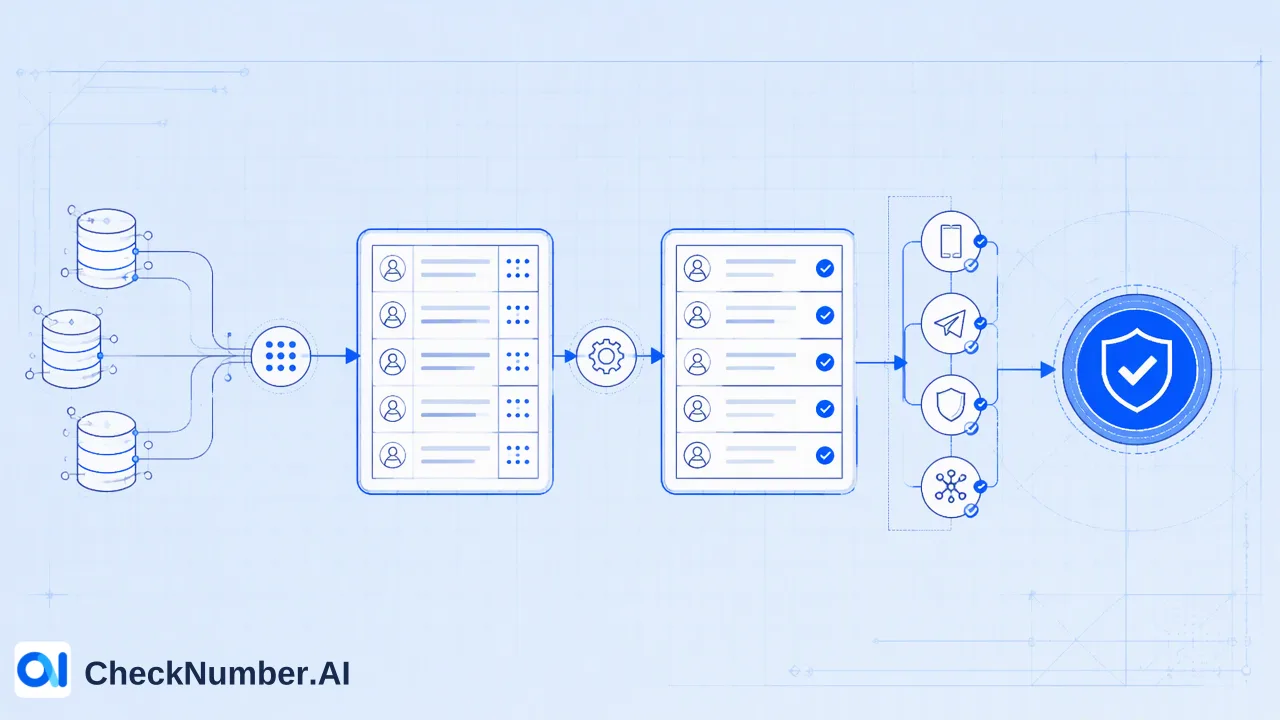
Customer list preparation for social media audience matching requires transforming raw CRM records into standardized, platform-matchable identifiers. Effective audience matching depends on data quality and platform presence rather than raw list volume. By normalizing phone numbers and email addresses and evaluating platform-specific registration signals at check time, marketing and technical teams can filter stale contacts, support segmentation accuracy, and focus audience budgets on reachable accounts.
The Gap Between CRM Records and Matchable Identifiers
A common misconception in digital marketing operations is that large CRM databases automatically translate into large, responsive custom audiences. In practice, raw list volume does not correlate directly with platform match rates. Customer relationship management systems accumulate data over years, often collecting legacy landlines, disposable email addresses, partial entries, and churned accounts. Social media advertising networks match uploaded customer lists by hashing identifiers—primarily phone numbers and email addresses—using cryptographic algorithms such as SHA-256, and comparing those hashes against current internal user profiles. A CRM record is a comprehensive business asset containing notes, purchase history, and account tags, whereas a platform-matchable identifier is a clean, singular technical token. When lists contain stale or non-registered identifiers, platform matching algorithms simply discard the rows. Uploading unrefined data distorts campaign size forecasts and wastes operational effort. Preparing lists requires recognizing that match rates reflect the hygiene and platform relevance of each record, not database size.
Standardizing Your Data for Platform Compatibility
Before evaluating account activity or channel signals, teams must standardize contact data to ensure ingestion compatibility across ad managers. Format and normalization checks are foundational: they address structural validity but do not evaluate whether an account actually exists on a given network. To standardize identifiers effectively:
- Phone Number Normalization: Ad platforms require phone numbers formatted with country codes, area codes, and subscriber numbers, stripped of spaces, hyphens, parentheses, and leading zeros. Normalizing entries into standard international formats ensures consistent cryptographic hashing. * Email Standardization: Email addresses should be trimmed of whitespace, converted to lowercase, and evaluated for basic syntax integrity. Standardizing domains and eliminating syntax errors prevents immediate platform parsing rejection. * Identifier Separation: Rather than combining multiple contacts into a single customer row, each phone number and email address should be organized into separate matching fields or distinct rows according to the target network’s template guidelines. Executing these normalization steps ensures that discrepancies in punctuation or casing do not cause hashing mismatches during file processing.
Refining Segments with Platform-Specific Signals
Once records are standardized, organizations can refine their audience segments using platform-specific signals. CheckNumber.AI provides bulk checking workflows that evaluate whether phone numbers and email lists possess account presence on supported networks. A platform-registration signal indicates account presence at check time. For instance:
- Ecosystem Segmentation: Identifying iMessage-registered numbers in bulk supports iOS and Apple ecosystem audience segmentation, assisting teams in planning channel-specific creative or tailored campaign routing. * Messaging Network Registration: Verifying whether contacts are registered on networks like Telegram provides presence context, helping teams separate reachable mobile profiles from non-messaging contacts. * Audience Signal Prioritization: Screening lists with high-value audience checkers flags relevant account signals across phone lists, supporting review workflows and helping teams prioritize high-intent segments. Integrating these signals into audience preparation allows teams to split generic lists into targeted tiers based on verified platform reachability.
A Workflow for Platform-Ready Audience Lists
Moving from an unorganized CRM database to an optimized audience file requires a disciplined four-stage process. | Stage | Core Action | Objective | | :--- | :--- | :--- | | 1. Export & Isolate | Extract phone numbers, emails, and CRM tags into clean columns. | Separate business metadata from matchable identifiers. | | 2. Normalize | Apply international phone formatting and clean email syntax. | Ensure technical compatibility with platform hashing rules. | | 3. Bulk Verification | Run lists through bulk checking workflows via CSV/TXT or REST API. | Identify platform presence and gather reachability signals. | | 4. Filter & Segment | Remove unregistered entries and group contacts by platform presence. | Create tailored files ready for ad network custom audience upload. | Using CheckNumber.AI, marketing operations teams can process lists using simple CSV or TXT file uploads for batch preparation, or integrate REST API endpoints into recurring pipeline automations. By filtering out unverified records before upload, organizations maintain tighter audience lists, refine targeting parameters, and support more efficient campaign execution.
FAQ
Why does a CRM list experience low match rates on social ad platforms?
Raw CRM databases often contain formatting discrepancies, inactive contacts, landline numbers, and outdated email addresses. Advertising networks rely on exact cryptographic hash matches against active user accounts. If contact details are improperly formatted or tied to accounts no longer present on the target network, the platform cannot match the record, reducing overall match rates.
How do platform-registration signals inform audience segmentation?
A platform-registration signal indicates account presence on a specific service at the time of the check. For example, knowing whether contacts are registered on messaging networks or iOS ecosystems helps marketing teams prioritize relevant delivery channels and tailor campaign segments.
What distinguishes a raw CRM record from a platform-matchable identifier?
A raw CRM record is an internal database entry that frequently includes incomplete names, local phone formatting, multiple notes, and historical emails. A platform-matchable identifier is an isolated, standardized data point—such as an internationally normalized phone number or canonical email address—verified as active or formatted to meet advertising network ingestion standards.
How does bulk phone and email checking support campaign planning?
Bulk checking through services like CheckNumber.AI helps teams evaluate contact lists using CSV or TXT file uploads or REST API workflows. This process identifies supported platform presence and flags audience signals before custom audience files are generated, helping teams exclude unmatchable records and organize campaigns around verified channel presence.