CheckNumber.AI
 · 5 min read
How to Evaluate Data Screening Tools for Your Contact Lists
A guide for businesses on evaluating data screening tools for contact lists, focusing on selecting the right intelligence signals—such as carrier data and platform registration—for operational workflows.

Evaluating contact list screening tools requires matching your business goals to specific data signals. Determine if your workflow requires carrier intelligence—such as line type and regional context—or platform-specific registration signals for audience segmentation. By focusing on the specific capabilities of your screening tools, you can better align your contact list management with your operational requirements. CheckNumber.AI supports these workflows by providing distinct tools for bulk phone-number and email list checking, ensuring teams can select the exact signal needed for their internal processes.
Defining Your Data Intelligence Needs
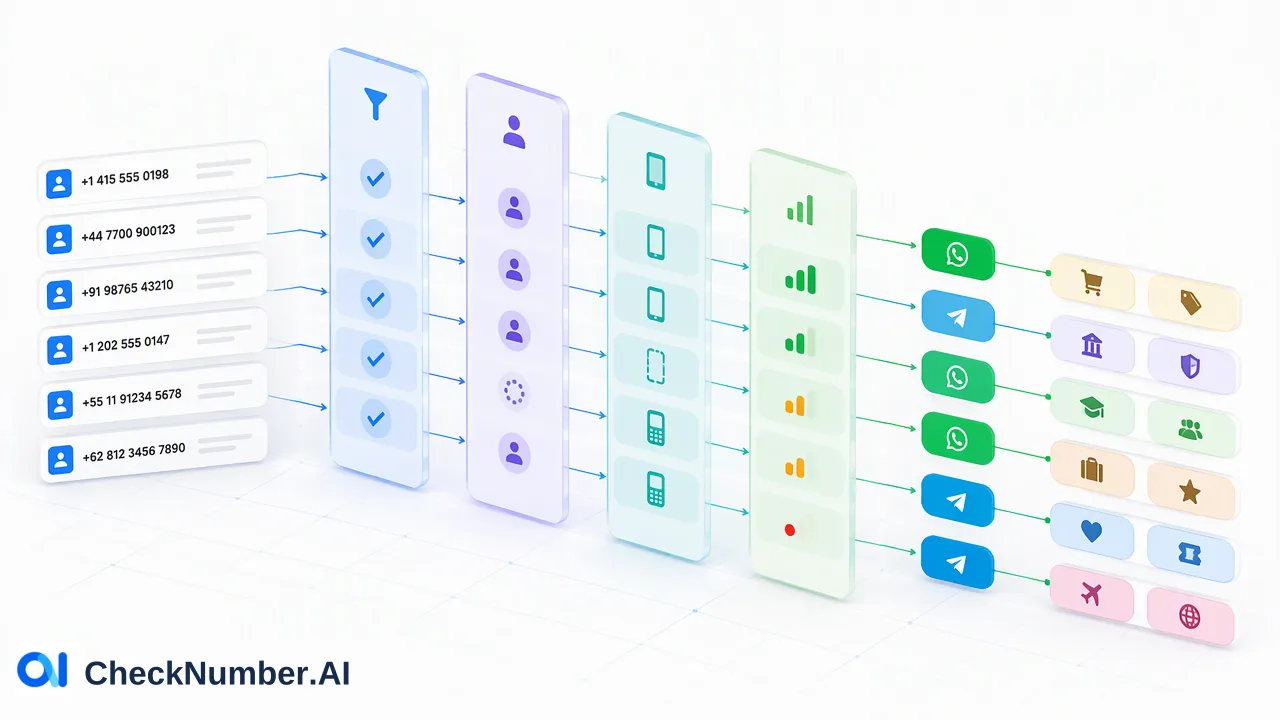
Start by categorizing the data needs of your organization. Effective contact list screening tool evaluation depends on selecting tools based on specific signal capabilities rather than relying on generic validation concepts. Different products expose different high-level capabilities, and a capability must not be transferred from one product to another. For example, a tool designed to identify a telecom provider serves a fundamentally different purpose than a tool built to check if a number is registered on a specific messaging app. When teams clearly define whether they need network-level data or application-level presence, they can integrate the correct bulk checking workflows into their systems. This targeted approach helps teams review their contact lists more efficiently and supports prioritization during outreach planning.
Understanding Carrier Intelligence
Carrier intelligence provides insights into the carrier, line type, and regional context for phone numbers. This type of data signal helps organizations understand the underlying telecommunications infrastructure associated with a contact list. When evaluating tools for this purpose, it is important to match the geographic scope of the tool to your operational footprint. For instance, the Global Carrier Checker identifies the carrier, line type, country, and regional context for phone numbers across various supported countries. Conversely, if a workflow is strictly focused on North America, the Advanced US Carrier Checker identifies the carrier, line type, and regional context specifically for United States and Canada phone numbers. Utilizing these specific carrier intelligence and location signals informs internal decisions regarding how to route communications or format data, distinct from any platform registration or activity metrics.
Leveraging Platform Registration Signals
Platform registration signals indicate whether a phone number is associated with a specific platform account. Unlike carrier intelligence, which looks at the network level, platform signals focus on ecosystem presence. A prime example is the iMessage Checker, which identifies iMessage-registered numbers in bulk. This capability supports iOS and Apple ecosystem audience segmentation, as well as iMessage outreach or support planning. By identifying which numbers in a contact list are registered on the iMessage platform, teams gain context that can be one input alongside other checks when designing communication strategies.
Integrating Screening into Your Workflow
Once the appropriate signals are selected, the next step in contact list screening tool evaluation is assessing how these tools integrate into existing operations. The core workflow for CheckNumber.AI involves the bulk checking of supported phone-number or email lists. To accommodate different technical requirements, bulk workflows support CSV or TXT list uploads for manual or batch processing. For automated system integration, REST API access is available. When implementing the API, developers must reference only the documented POST /api/v1/check endpoint, utilizing the X-API-Key header for authentication and including the service_type body field to specify the requested check. This standardized approach ensures that whether a team is requesting carrier intelligence or platform registration signals, the technical implementation remains consistent and strictly scoped to the documented capabilities.
Distinguishing Between Signal Types for Better Data Hygiene
A common challenge during contact list screening tool evaluation is the risk of conflating carrier intelligence with platform registration signals. Carrier intelligence is distinct from platform registration and activity. A phone number might have a valid carrier and line type but not be registered on a specific messaging platform, or vice versa. Treating these distinct data points as a single validation metric obscures valuable context. By maintaining a clear separation between network-level carrier data and application-level account presence, organizations can build more nuanced data hygiene practices.
FAQ
What is the difference between carrier intelligence and platform registration?
Carrier intelligence provides data signals identifying the carrier, line type, and regional context of a phone number. In contrast, a platform registration signal indicates whether a phone number is associated with a specific platform account, such as iMessage. Carrier intelligence is distinct from platform registration and activity.
How do I choose between different carrier checking tools?
Choosing a carrier checking tool depends on your geographic requirements. The Global Carrier Checker identifies carrier, line type, country, and regional context across supported countries. If your focus is narrower, the Advanced US Carrier Checker provides carrier, line type, and regional context specifically for United States and Canada phone numbers.
What file formats are standard for bulk contact list screening?
For manual or batch processing, bulk workflows support CSV or TXT list uploads. This allows teams to process large contact lists efficiently without requiring complex technical integration.
How is REST API access structured for these screening tools?
REST API access is structured around a specific endpoint. Integrations must use the documented POST /api/v1/check endpoint, which requires the X-API-Key header and the service_type body field to define the exact signal being requested.