CheckNumber.AI
 · 8 min read
Carrier and Line-Type Data: The Complete Guide
A comprehensive guide to understanding carrier intelligence and line-type data, explaining how telecom attributes inform communication routing, voice delivery, and operational workflows.
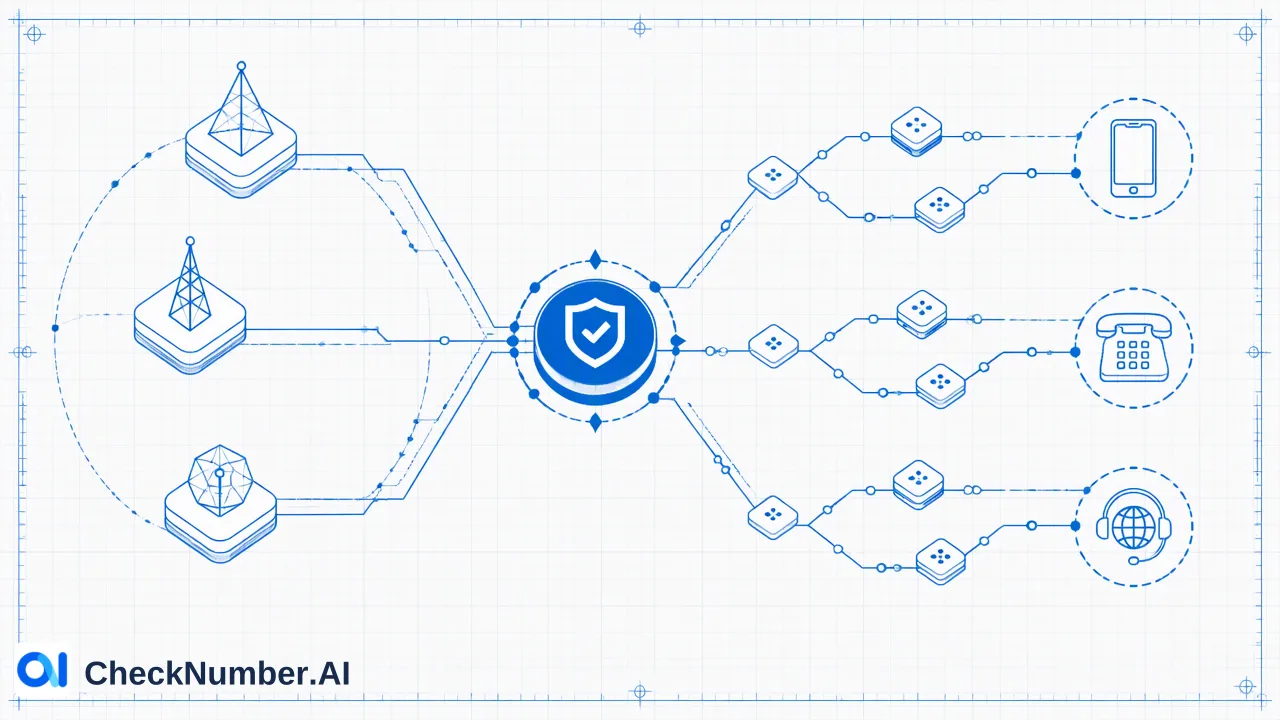
Carrier and line-type data provide essential telecom context for a phone number, identifying its servicing carrier, administrative line type (such as mobile, landline, or VoIP), country, and regional context. These telecom attributes are distinct from platform-specific registration signals, which indicate whether an identifier is registered with an external application like LINE or Telegram at check time. Organizations use carrier intelligence to inform message routing, prioritize voice versus SMS channels, and maintain clean contact records across bulk communication workflows.
Understanding Carrier Intelligence and Telecom Attributes
Telecommunications networks are organized around complex numbering plans, carrier allocations, and infrastructure categories. When an organization interacts with customer or partner contact records, evaluating a phone number requires more than simple syntax validation. Format or normalization checks confirm only whether a string adheres to standard numerical lengths, prefixes, or E.164 standardization conventions. In contrast, carrier intelligence identifies the active network provider, the specific line classification, the country of origin, and relevant regional context. Carrier intelligence helps organizations look deeper into the structural properties of an identifier. Standard carrier checks determine whether a number belongs to an established mobile network operator, an incumbent local exchange carrier, or a digital telephony provider. At a high level, global carrier intelligence addresses numbers across international markets, while specialized checks, such as advanced US carrier queries, evaluate regional contexts specific to the United States and Canada numbering plans. Understanding these telecom attributes provides critical visibility into how phone numbers are provisioned and maintained. Because telephone numbering blocks are systematically assigned to specific telecommunications entities, inspecting carrier and location signals helps operational teams understand the foundational telecommunications context of every contact record on their lists.
The Core Line Types: Mobile, Landline, and VoIP
A central dimension of carrier intelligence is the line-type attribute. Telecommunications regulators and service providers categorize telephone lines based on their underlying architecture and transmission technology. The three primary classifications encountered in enterprise operations include:
- Mobile (Wireless): Mobile lines are assigned to cellular network operators and correspond to wireless devices equipped with SIM cards or eSIM profiles. These lines natively support both standard two-way voice calling and short message service (SMS). They represent the standard channel for mobile messaging. * Landline (Fixed-Line / Wireline): Landlines are tied to physical copper or fiber-optic telecommunications wiring connected to homes, commercial offices, or private branch exchanges (PBX). Traditional landlines support voice communications but generally lack native support for cellular SMS protocols. Directing SMS traffic to a fixed-line number typically results in undeliverable messages, delivery bounces, and wasted messaging spend. * VoIP (Voice over Internet Protocol): VoIP lines route calls and messages across packet-switched data networks and internet connections rather than the traditional Public Switched Telephone Network (PSTN). VoIP numbers can be hosted by cloud communication platforms, digital PBX vendors, or web-based calling applications. Because VoIP accounts can be spun up or reassigned programmatically, their operational profile differs substantially from fixed or cellular lines. | Line Type | Primary Infrastructure | SMS Viability | Common Operational Role | | :--- | :--- | :--- | :--- | | Mobile | Cellular wireless networks | Native two-way SMS supported | Mobile outreach, two-factor authentication, SMS updates | | Landline | Physical wireline (copper/fiber) | Voice only; standard SMS fails | Office reception, inbound voice, landline-based call centers | | VoIP | Internet protocol data networks | Dependent on provider configuration | Virtual call centers, remote PBX, disposable or web telephony | In addition to these core classifications, numbers frequently undergo mobile number portability (MNP) or local number portability (LNP). Portability regulations permit consumers and enterprises to transfer their existing telephone numbers between different network operators or between line types—such as porting a legacy copper landline into a cloud VoIP provider, or migrating between cellular providers. As a result, static assumptions about a number’s line type based purely on area code or prefix become obsolete over time, underscoring the value of carrier intelligence checks.
How Line-Type Data Informs Communication Routing
For organizations executing transactional outreach, marketing distributions, or customer support operations, line-type data serves as a practical foundation for channel routing decisions. Misaligned message dispatching introduces operational friction, degrades delivery statistics, and incurs avoidable platform costs. 1. Directing SMS and Voice Channels: When a customer record is classified as a landline, automated communication platforms can immediately bypass the SMS gateway and route outbound notifications to voice channels or alternative messaging channels. Reserving SMS campaigns strictly for confirmed mobile lines helps teams preserve marketing budgets and maintain clean delivery metrics. 2. Addressing Virtual and VoIP Numbers: Virtual phone numbers provisioned through VoIP platforms present unique operational considerations. While many VoIP numbers support SMS via cloud APIs, others do not support short-code or transactional messaging. In risk-sensitive workflows, such as account signups or high-value transactions, identifying a VoIP line provides context that can inform internal review rules or prompt step-up verification without assuming the user is fraudulent. 3. Regional and Geographic Routing: Carrier checks provide regional context and country identification. Understanding the geographic jurisdiction associated with a phone number supports compliance with localized calling windows, time-zone restrictions, and regional telecommunications frameworks across North America and global markets. By incorporating carrier and line-type classification into communication engines, organizations can systematically route every contact record through its most viable and cost-effective channel.
Carrier Intelligence vs. Platform Registration Signals
A common point of confusion in data enrichment and verification is the relationship between carrier intelligence and platform-specific registration signals. While both derive from a phone number, they evaluate entirely different operational layers. * Carrier Intelligence: Operates at the telecommunications network tier. It identifies the network carrier, the physical or virtual line type, the country code, and the regional context. Carrier intelligence indicates how a number is provisioned within the telecom ecosystem. * Platform Registration Signals: Operate at the application layer. CheckNumber.AI provides dedicated platform checkers, such as the Line Checker and Telegram Checker, which evaluate whether a specific phone number is registered with an external application at the time of the check. Additional enriched checks, such as the Line Profile Checker or Telegram Days Checker, surface platform-specific metadata, activity context, or profile enrichment when available on those networks. | Attribute | Carrier Intelligence | Platform Registration Signal | | :--- | :--- | :--- | | | Operational Level | Telecommunications infrastructure (carrier, switch, line type) | Over-the-top application layer (LINE, Telegram) | | Primary Output | Carrier name, line type (mobile/landline/VoIP), country, region | Account presence, platform reachability at check time | | Scope Example | Global Carrier Checker, Advanced US Carrier Checker | Line Checker, Telegram Checker | | Workflow Purpose | Channel routing (SMS vs. voice), telecom network validation | Application-specific messaging, platform reachability review | Similarly, carrier intelligence confirms the network provider and line type, but it does not confirm who is operating the device. Organizations combine both signals to build a complete, layered view of their contact databases.
Operationalizing Data Within Bulk Workflows
For businesses managing large databases, running one-off queries manually is inefficient. CheckNumber.AI provides bulk phone-number and email list checking services designed to handle extensive data volumes systematically. Organizations can integrate carrier and line-type lookups into their operational pipelines using two primary intake methods:
- CSV and TXT List Uploads: Operational and marketing teams can upload contact lists formatted as standard CSV or plain TXT files. Bulk list processing applies carrier checks across thousands of records simultaneously, outputting enriched files that categorize each number by carrier, line type, and geographic context. * REST API Access: Technical teams can integrate programmatic queries directly into backend onboarding flows, CRM pipelines, or communication engines via the REST API. This supports automated pre-routing classification as soon as a record enters the database. Because different products expose distinct high-level capabilities, organizations should select the specific tool suited to their geographical and analytical requirements—such as the Global Carrier Checker for broad international coverage or the Advanced US Carrier Checker for North American regional depth.
FAQ
What is the difference between a mobile and a VoIP line?
A mobile line is assigned through a cellular carrier and operates directly on physical wireless radio networks, supporting native cellular voice and SMS services. A VoIP (Voice over Internet Protocol) line routes communications over data networks and internet connections rather than traditional physical telephone switches. Because VoIP numbers can be created, transferred, and managed virtually through software platforms, organizations frequently classify them separately from physical mobile or landline numbers during routing and risk reviews.
How does carrier data support communication routing decisions?
Carrier and line-type intelligence informs communication systems about which transmission channel is structurally viable for a given number. Identifying whether a destination line is mobile, landline, or VoIP helps systems route voice traffic to landlines, reserve SMS for verified mobile lines, and apply specialized delivery handling for virtual providers.
How do platform registration signals differ from carrier data?
Carrier intelligence provides telecom-level infrastructure data, such as carrier name, line type, country code, and regional assignment. In contrast, a platform registration signal checks whether a phone number is registered with a specific third-party messaging platform (such as LINE or Telegram) at the exact moment of inquiry.