CheckNumber.AI
 · 3 min read
How to Plan a Bulk Verification API Workflow
A guide to architecting a bulk verification workflow using CheckNumber.AI, focusing on selecting appropriate contact intelligence signals and managing list-based processing.

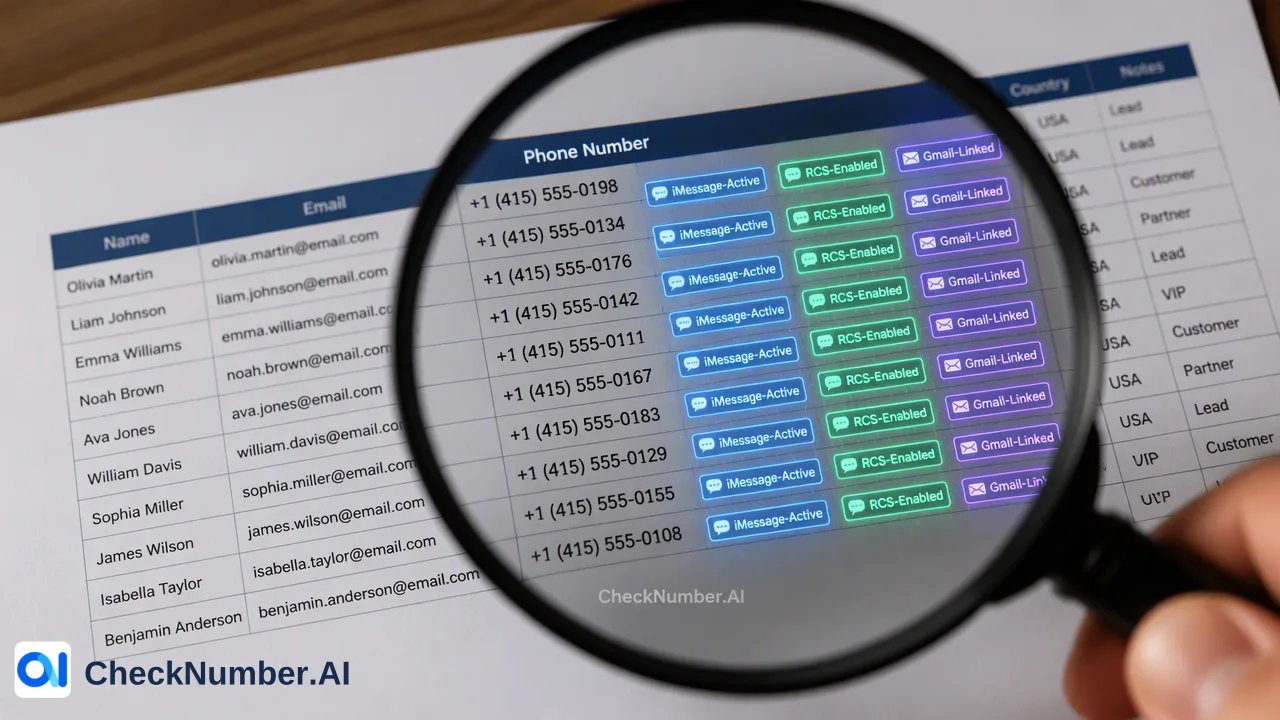
A successful bulk phone verification API workflow involves identifying the specific contact intelligence required—such as carrier data, RCS capability, or email registration status—and choosing the appropriate submission method. Organizations can submit supported phone-number or email lists via CSV or TXT file uploads, or integrate directly using REST API access. By aligning the signal type with your business objective, you can effectively categorize and manage your contact lists to support downstream operations.
Defining Your Verification Objectives
Planning a bulk checking process starts with selecting the right contact intelligence signal for your specific list. Different products expose different high-level capabilities, and it is important to maintain a clear separation between them. For phone numbers, the Global Carrier Checker helps identify the carrier, line type, country, and regional context across supported countries. If your goal involves rich-messaging audience planning, the RCS Checker identifies phone numbers that support RCS or Google Messages by providing a platform registration signal. For email lists, Email Validation checks registration signals across supported email providers. Selecting the correct capability supports your internal review processes by providing the exact intelligence needed.
Choosing Your Submission Method
Once you determine the necessary contact intelligence signals, the next step is establishing how to submit your data. The core workflow for CheckNumber.AI is the bulk checking of supported phone-number or email lists. Teams can choose between two primary input methods based on their operational requirements. For manual or batch processing, bulk workflows support CSV or TXT list uploads. For automated, programmatic workflows, REST API access is available. Both methods support the submission of lists to retrieve the selected product’s specific signal.
Integrating Signals into Your Workflow
After retrieving the requested data, the final step is integrating these signals into your broader systems. Contact intelligence serves as a decision-support input that informs internal decisions. For example, carrier intelligence and location signals can help teams review regional routing strategies, while RCS capability signals support the planning of rich-messaging campaigns. It is critical to remember that a capability must not be transferred from one product to another; carrier intelligence is distinct from platform registration signals. By applying the specific outputs from the Global Carrier Checker, RCS Checker, or Email Validation tools, organizations can structure their internal review processes and categorize contact lists accurately.
FAQ
What file formats are supported for bulk uploads?
Bulk workflows support CSV or TXT list uploads for batch processing of supported phone-number or email lists.
Can I use the same API for carrier and email checks?
While REST API access is available for bulk workflows, different products expose different high-level capabilities. Carrier intelligence is handled by the Global Carrier Checker, while email registration signals are handled by Email Validation. A capability must not be transferred from one product to another.
How do I choose between file uploads and API integration?
CSV or TXT list uploads are typically used for manual batch processing, whereas REST API access supports automated, programmatic workflows. Both methods facilitate the core workflow of bulk checking supported lists.