CheckNumber.AI
 · 5 min read
How to Validate and Segment US Phone Lists by Carrier for Targeted Outreach
Learn how bulk phone number carrier validation and structured list hygiene help teams identify line types, navigate mobile number portability, and improve US outreach workflows.
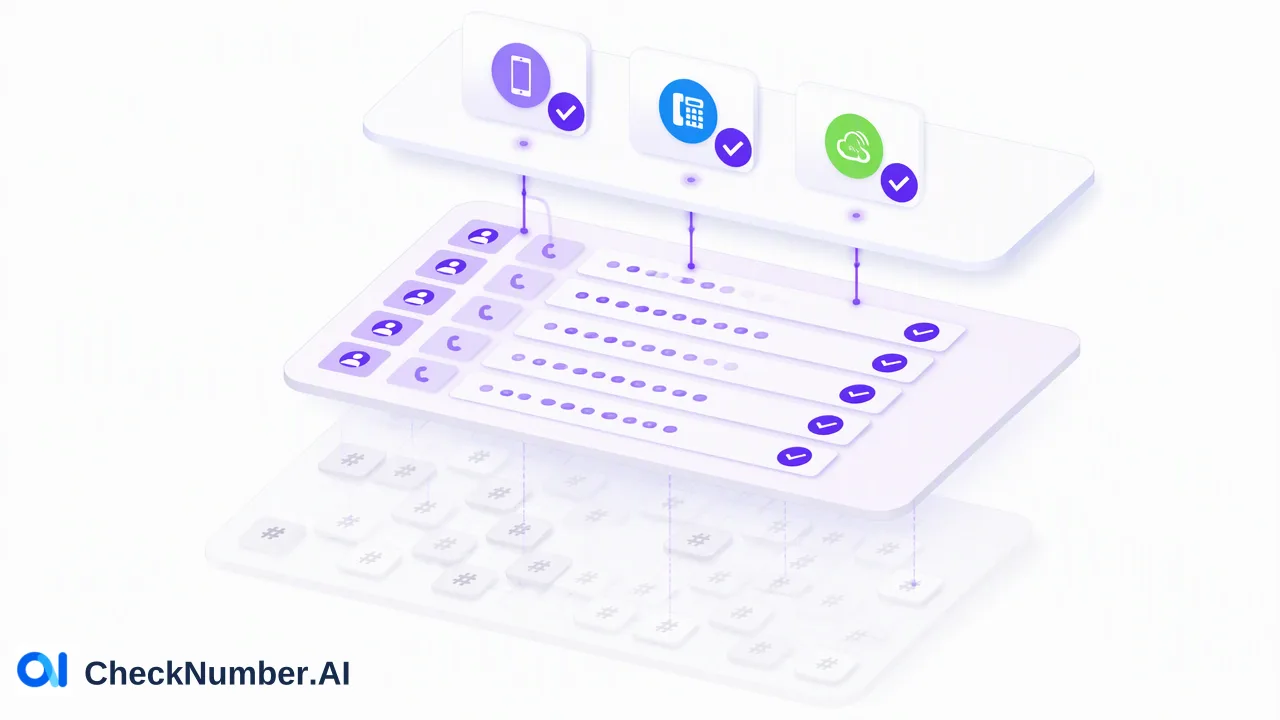
Accurate carrier identification is essential for effective US outreach because mobile number portability decouples telephone numbers from their original network prefixes. Organizations cannot rely on static prefix tables to determine whether a record belongs to a major carrier, a regional provider, or a virtual service. Establishing reliable segmentation requires a systematic workflow: standardizing phone number formats, deduplicating records across the dataset, and applying bulk phone number carrier validation to identify current line types, carrier names, and regional context.
The Challenge of Carrier Identification in the US
Managing US contact lists involves navigating the North American Numbering Plan, where area codes and three-digit central office prefixes historically pinpointed exact geographic regions and telecommunications carriers. Under this legacy model, teams could reference static prefix tables to guess the network operator associated with a given phone number. This approach is obsolete in modern outreach. The widespread adoption of Mobile Number Portability (MNP) enables consumers and commercial subscribers to retain their exact phone numbers when switching service providers. Furthermore, numbers frequently transition across line categories—such as transferring a traditional wireline number to a wireless mobile carrier or porting a mobile number to an interconnected Voice over IP (VoIP) provider. Because porting activity occurs continuously, static database tables quickly decay. Outreach teams that rely on prefix-based assumptions risk routing communications to incorrect networks or attempting text-based campaigns on incompatible wireline numbers. Implementing bulk phone number carrier validation provides current carrier intelligence, allowing organizations to maintain clean list architecture based on verified routing data rather than outdated prefix assignments.
Establishing a Data Hygiene Workflow
Before submitting contact lists for carrier detection, organizations must establish a rigorous data hygiene pipeline. Raw lists collected from web forms, customer relationship management (CRM) systems, and registration databases routinely contain formatting inconsistencies, typographical anomalies, and duplicate records that distort analytics. A systematic list-cleaning workflow involves three preliminary stages:
- International Format Standardization: Contact numbers must be standardized into consistent international formats, such as the standard E.164 convention (e.g., +1 followed by the 10-digit national number for the United States). Removing extraneous formatting characters—such as parentheses, hyphens, spaces, and local dialing prefixes—ensures that downstream checking systems interpret each record unambiguously. 2. Deduplication: Redundant phone records inflate list volumes and lead to duplicate messaging attempts. Deduplicating records across campaigns preserves reporting accuracy, protects team reputation, and eliminates wasted validation overhead. 3. Basic Number Validation: Prior to carrier segmentation, lists benefit from baseline phone number validation to verify that strings represent structurally sound, allocated numbers, filtering out incomplete digits or invalid test entries. CheckNumber.AI accommodates these bulk workflows by supporting CSV and TXT list uploads alongside direct REST API access. This flexibility helps teams process extensive databases systematically without manual parsing.
The Role of Carrier Intelligence in Segmentation
Carrier intelligence provides granular attributes about each telephone number, moving beyond whether a number merely exists to reveal its operational network profile. Through CheckNumber.AI’s Global Carrier Checker, organizations can identify carrier identity, line type, country, and regional context across their contact base. The primary line types identified through carrier intelligence include:
| Line Type | Technical Characteristics | Outreach Role |
|---|---|---|
| Mobile | Assigned to commercial wireless operators; natively supports standard cellular voice and SMS protocols. | Supports SMS, MMS, and mobile-first calling workflows. |
| Landline | Fixed-wire telecommunications connections terminating at physical residences or commercial premises. | Suitable for standard voice calling; unsuited for standard SMS outreach. |
| VoIP | Virtual numbers routed over data networks; often utilized by softphones, call centers, and PBX systems. | Informs fraud risk review and tailored customer support routing. |
| Access to current carrier and line-type metadata helps teams segment their databases effectively. Rather than broadcasting uniform communications across an undifferentiated list, outreach managers can separate mobile numbers for text-driven campaigns, divert landline contacts to dedicated call queues, and flag high-risk VoIP allocations for secondary verification. This strategic partitioning supports higher operational efficiency and informs smarter resource allocation. |
Distinguishing Validation from Platform Registration
When architecting an outreach pipeline, technical teams must maintain a clear boundary between carrier validation and downstream communication signals. While both provide valuable operational data, they serve distinct evaluation stages. * Carrier Detection: Identifies the telecommunications service provider, underlying line classification (Mobile, Landline, VoIP), and regional geographic context. It answers whether the number is configured as a cellular, fixed, or virtual line on the telecommunications network. * Reachability and Live Line Checks: Carrier intelligence indicates channel compatibility (e.g., whether a line can receive SMS), but it does not evaluate temporary line state, device power status, or immediate network reachability. * Platform Registration Signals: Independent tools, such as an iMessage Checker or Telegram Checker, verify whether a phone number is registered on a specific messaging ecosystem. For instance, iMessage checks support iOS and Apple ecosystem audience segmentation for targeted communications, while Telegram checks establish platform registration status. Integrating carrier validation alongside selective platform-registration tools gives organizations a multi-layered segmentation strategy, ensuring messages are routed through channels matched to each contact’s technical profile.
FAQ
Why is prefix-based carrier lookup inaccurate?
Prefix-based lookups rely on historical North American Numbering Plan allocations that assign area codes and central office prefixes to specific carriers. Because mobile number portability allows subscribers to retain their phone numbers when changing wireless providers or switching between wireline and wireless networks, the initial prefix no longer indicates the active network servicing that line.
What is the difference between phone number validation and carrier detection?
Phone number validation checks whether a number conforms to structural rules and represents an active, valid numbering assignment. Carrier detection provides deeper technical intelligence on valid numbers by identifying the specific network operator, line type such as Mobile, VoIP, or Landline, and regional geographic context.
How does carrier segmentation improve outreach performance?
Carrier segmentation helps teams categorize contact records into distinct technical classifications before launching campaigns. By isolating mobile numbers from landline and virtual VoIP numbers, organizations can route communications through compatible channels, reduce non-delivery errors, and support more efficient campaign budgeting.