CheckNumber.AI
· 5 min read
Reverse Phone Lookup or Number Validation: What Does Your Customer List Need?
Choose a check by the question your team needs answered, then interpret each result within that question.
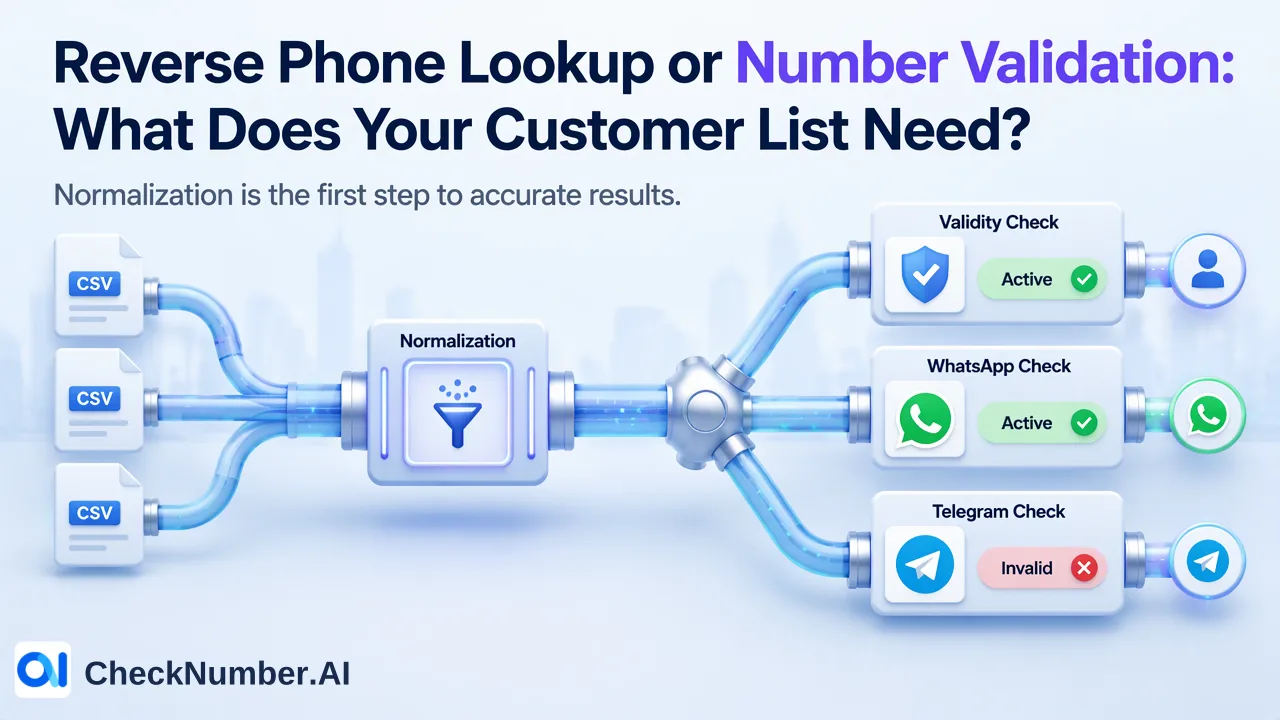
If you already hold a customer phone list, reverse lookup, number validation, and a platform check answer three different questions. Start with the business decision the result will support.
Start with the decision, not the phrase “check number”
A retailer has 4,000 phone numbers from order and support forms. Some agents want to know who called the service line yesterday. The campaign team wants to clean its contact list. Another team wants to know which existing contacts have a WhatsApp account before planning an approved channel campaign. All three people might search for a way to “check a number,” yet they need different answers.
Reverse phone lookup starts with an unknown incoming number and seeks a caller name or other identity clue. Phone number validation starts with a number already held and asks whether it passes a validity check. A named platform check asks whether that number has a signal for a selected service, such as WhatsApp or Telegram. A positive signal on one service says nothing about a different service.
Write the intended decision beside the list before buying or running checks. “Identify yesterday’s caller” points toward a caller lookup service. “Remove invalid rows before the next import” points toward validation. “Plan a WhatsApp segment from contacts we already have permission to use” points toward a WhatsApp registration check. The distinction saves a list owner from treating a useful but unrelated result as the answer.
What CheckNumber can do with a customer list
Our Phone Number Validation and other number products are built around supplied phone numbers. CheckNumber documents Phone Number Validation for a validity signal and separate named platform products for registration signals. WhatsApp Number Checker checks WhatsApp account presence; Telegram Checker checks Telegram account presence. These are different product choices, not one universal “valid person” score.
For a bulk job, start with the authorized list you already maintain. The documented workflow accepts supported CSV or TXT inputs for applicable bulk checks. Number Cleaner can prepare numbers into E.164 form and remove duplicates or invalid entries before downstream checking. Keep the original customer record identifier alongside the cleaned number, so the result can be joined back to the right row. If two source rows collapse to one normalized number, do not silently assign the result to a different customer.
A cleaned input and a completed check are separate events. A formatting correction makes a row suitable for a particular check; it does not establish that a phone is currently used by your customer. A validity result answers the validity question for that check. A WhatsApp result answers the WhatsApp registration question at check time. In your export or CRM, name the result after the product used and retain the check date. “WhatsApp registered on November 23” is much clearer than “verified.”
Keep identity and permission in the right workflow
Suppose the support team receives an unknown call from the same number that appears in an order record. A platform signal cannot tell the agent who placed the call. It also cannot prove that the person who submitted the form still controls the number. If the team needs to change an address or release order information, use its existing customer authentication process. If it needs permission to send a campaign, consult the consent record and channel rules. Do not replace either step with an account-presence result.
The useful handoff is simple: let the check answer one narrow question and let the customer system answer the relationship question. A list owner can mark a row “validity check completed,” “WhatsApp presence observed,” or “needs customer confirmation,” rather than collapsing these into a single good/bad field. This makes the next action visible. The campaign team may use a dated registration signal to plan a channel; support still confirms the person before making a sensitive change.
A result can also be unavailable or inconclusive. Keep that state distinct from a completed negative result and decide whether a later check is justified. Repeatedly running a different service to fill an identity gap will not turn a number-level signal into identity evidence.
Choose the first run
Pick a small authorized slice of the list that represents its countries and source forms. Document the question, choose Phone Number Validation or the specific platform product, prepare the phone values, and inspect the returned rows in the context of that product. Check whether normalization and duplicate handling preserve your customer mapping. Then decide whether the same question applies to the larger list.
If the business question is caller identity, use the team’s established caller investigation or direct customer confirmation instead of presenting CheckNumber as a reverse caller directory. If the question is a documented list signal, open our number checker products and select the check that matches the next action. The name of the check should remain in the final report so the person using it knows exactly what was learned.
FAQ
Does a valid phone number identify its owner?
No. A validity result concerns the number; an ownership or customer-identity decision requires a separate confirmation process.
Can a WhatsApp registration result replace consent to contact?
No. It is a dated platform presence signal. Use the permission recorded in your customer workflow for contact decisions.