CheckNumber.AI
· 5 min read
What to Check When a Phone Library Rejects a New Number Range
Investigate country context, installed metadata and official numbering evidence before discarding a disputed customer phone number.
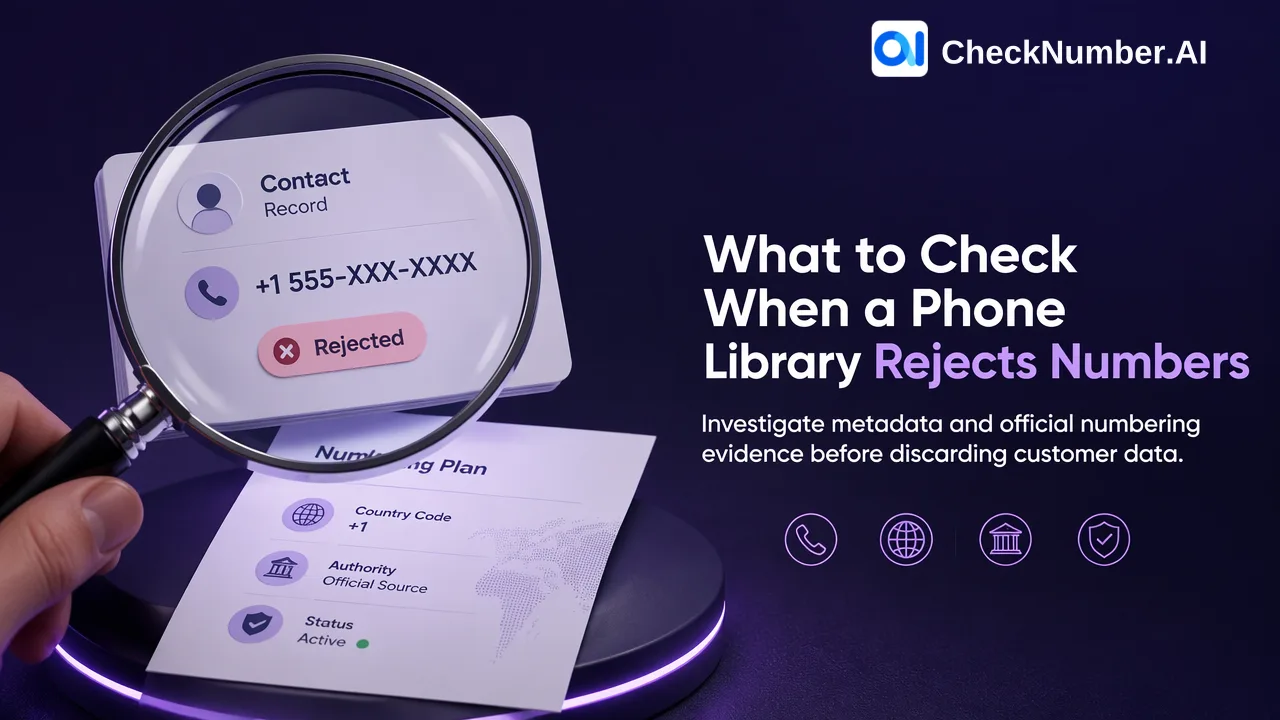
Treat a suspected new-range rejection as an investigation. Reproduce the result with the exact input and country context, compare the deployed library with current metadata, and find authoritative evidence for the range before deciding what to do with the record.
Capture the rejection before changing the number
A customer says their number is correct, but your import rejects it. Repeatedly removing a leading digit until the validator accepts something is a dangerous repair: the new value may identify a different number. Start by preserving the original input and the exact value that reached the library.
Record the default country supplied to parsing, the resulting country code if parsing succeeded, and the validation operation that failed. Distinguish a parsing error from a possible-length failure and a range-validity failure. A number missing country context is not yet evidence of a new numbering range.
Reproduce the case outside the surrounding form logic using the same deployed package and metadata. This reveals whether the rejection comes from the library or an additional application rule. A front-end mask, a cached regular expression or a server-side country restriction can reject input even when the phone library accepts it.
Check what version is actually running
Find the resolved dependency version in the deployed application, rather than reading only the version range in a package manifest. If the application bundles phone metadata separately, record that asset as well. A development machine can produce a different result from a deployed bundle that still contains an older build.
Repeat the same input and country context against the current maintained version in an isolated test. Keep the two results side by side. If the newer version accepts the range, inspect the relevant release or metadata change before planning an upgrade. Run representative existing numbers through the update too, especially countries central to your customer base.
If both versions reject the number, updating alone has not resolved the question. Continue with numbering evidence. Do not remove the validity check globally merely because one customer reports a valid number; that change would affect every subsequent submission, including genuinely malformed ones.
Look for evidence that addresses the exact range
Google’s libphonenumber FAQ describes a valid range as one for which sufficient official documentation indicates that numbers can be assigned. It also explains that metadata changes can lag the introduction of a range. That is a reason to investigate a rejection, not a reason to assume every unfamiliar prefix is newly valid.
Look for the relevant national telecommunications authority’s numbering plan or an official allocation notice. Match the country calling code, national number length and prefix boundaries. Check the effective date: an announcement about a future range may not establish that it is already available for assignment.
An operator’s authoritative notice can add context where the national plan is incomplete. Save the original URL, document date and the passage supporting the range in your investigation notes. A forum report or another website accepting the input can provide a lead, but it does not replace that evidence. A historical copy of a numbering FAQ explains the general issue; it cannot confirm a current allocation.
Choose a narrow response to the evidence
When current metadata accepts the number and older deployed metadata rejects it, test and release the supported update through your normal deployment process. Keep the reported number as a regression case so the same rejection does not quietly return with a later bundle change.
When an effective official allocation is missing from current metadata, prepare a concise upstream report with a reproducible input, country context and the authoritative source. Remove customer identity details from the report. Avoid publishing a customer’s full contact record when a permitted test case or range description can explain the issue.
For your own workflow, hold affected records in a disputed-range queue rather than deleting them or silently declaring them valid. Any temporary exception should be restricted to the evidenced range and the specific business decision. For example, allowing a user to save a contact record need not grant permission to begin every phone-dependent action. Document when the exception should be reviewed after metadata catches up.
Add a separate check only for the question it answers
A numbering-plan investigation and a bulk checking result are separate observations. CheckNumber’s Phone Number Validation provides a documented validity signal for supported lists. Other catalogue products answer different questions, such as registration on a named platform. Choose the product according to the decision your team needs to make.
Prepare approved candidates in CSV or TXT with one country per file and one number per line including the country code. Confirm the selected product’s current country coverage. Keep unresolved original inputs in your own review sheet, so a later export can be reconciled to the investigation rather than overwriting its notes.
A positive checking observation does not establish ownership or repair a missing official allocation record. Equally, a library rejection should not erase a separate observation without review. Store the source and time of each conclusion, then decide whether the customer record can proceed, needs correction or remains held.
Start with the reproducible rejection and the installed version. Once the range question is understood, use our phone number checker for the supported list-checking task that follows. This preserves the useful distinction between fixing your validation rule and understanding the contact list.