CheckNumber.AI
 · 5 min read
Beyond the Raw List: How to Select Enrichment Signals That Actually Improve Lead Quality
Effective data enrichment requires selecting specific platform signals that directly support lead qualification workflows rather than simply maximizing data volume.
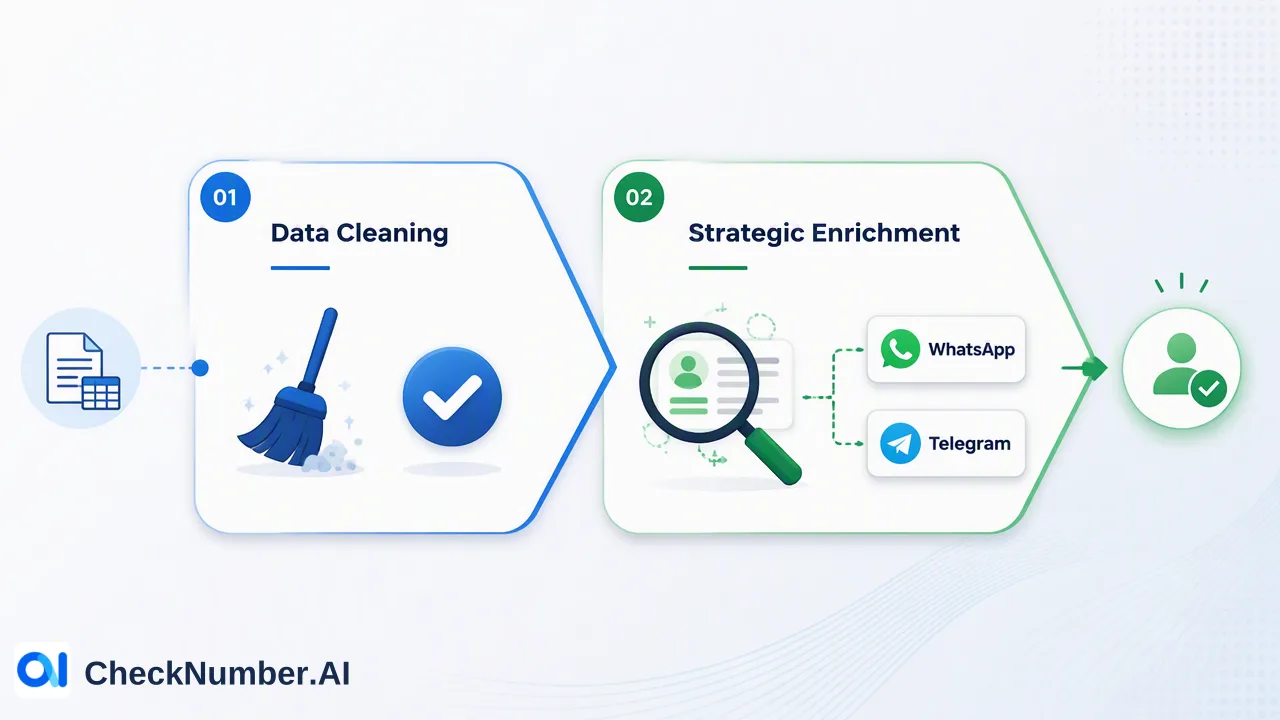
Effective data enrichment is not about increasing the number of fields per contact, but about selecting specific signals that answer defined business questions. By distinguishing between foundational data cleaning and strategic enrichment, teams can prioritize signals—such as platform registration or activity status—that directly inform outreach, segmentation, and prioritization workflows. A successful contact list enrichment strategy shifts the focus from raw data volume to actionable context, helping organizations align their contact data with specific regional and platform-based communication channels.
The Trap of Data Overload
Many organizations approach contact list enrichment by appending as many data points as possible to a single record. This often results in data overload, where teams possess vast amounts of information but lack the actionable context needed to improve lead qualification. Effective enrichment should be evaluated by its ability to answer a specific business question rather than just increasing data volume. When teams prioritize quantity over utility, they risk complicating their workflows with irrelevant fields that do not support their primary outreach channels. A targeted contact list enrichment strategy requires organizations to identify the exact data points that will inform their next steps, such as determining whether a phone number maintains an account-related presence on a specific messaging platform. By focusing on signals that directly support existing lead qualification workflows, teams can avoid the trap of treating all social media or demographic data as a single broad category.
Cleaning vs. Enrichment: Establishing a Foundation
Before adding new dimensions to a contact record, organizations must establish a baseline of data accuracy. It is critical to distinguish between data cleaning and data enrichment. Data cleaning is the process of improving existing fields, such as performing format or normalization checks to confirm a phone number adheres to standard structures like E.164. Foundational checks, including basic format validation, are prerequisites for effective enrichment. They confirm that the underlying data is correctly structured before any further analysis occurs. In contrast, data enrichment is the process of adding new dimensions to a contact record to provide context for sales or marketing workflows. Once a list of phone numbers or emails has been cleaned and normalized, enrichment introduces supplementary signals—such as platform registration status or profile context. Organizations often manage these processes through bulk workflows that support CSV or TXT list uploads, as well as REST API access for automated pipeline integration. By separating the foundational step of cleaning from the strategic step of enrichment, teams can build a more reliable and actionable contact database.
Selecting Signals That Drive Workflow Efficiency
A useful enrichment field must be precise, actionable, and directly tied to a defined sales or marketing workflow. Rather than appending generic data, organizations should prioritize platform-specific signals that match their primary outreach channels. For example, checking a phone number for platform registration provides account-related presence context for specific applications at the time of the check. When evaluating a contact list enrichment strategy, teams can utilize specific checkers to gather relevant context. The WhatsApp Days Checker provides a platform registration signal, an activity signal, and available business-profile context. Similarly, the Telegram Username Profile Checker checks usernames for registration and available public profile information, adding another layer of context for teams utilizing that platform. These signals act as decision-support inputs, helping teams route and prioritize leads based on documented platform presence rather than assumptions.
Aligning Enrichment with Regional Outreach
Communication preferences vary significantly across different regions, making it essential to map enrichment signals to the platforms buyers actually use in specific markets. A contact list enrichment strategy that works in one region may be ineffective in another if it relies on the wrong platform signals. For messaging-first markets, such as parts of Southeast Asia or Latin America, organizations benefit from utilizing WhatsApp or Telegram registration and activity signals. Identifying which numbers on a bulk list maintain an account-related presence on these platforms helps teams tailor their outreach to the most relevant channels. In other markets, the iMessage Checker can identify iMessage-registered numbers in bulk. This specific signal supports iOS and Apple ecosystem audience segmentation, which informs iMessage-focused outreach or support planning. By aligning the selected enrichment signals with regional communication habits, organizations can direct their data enrichment efforts to directly support localized marketing and sales workflows. This targeted approach focuses enrichment budgets and processing resources on signals that provide genuine operational value.
FAQ
What is the difference between data cleaning and data enrichment?
Data cleaning focuses on improving existing fields, such as applying format or normalization checks to confirm phone numbers meet standard structural requirements. Data enrichment is the subsequent process of adding new dimensions to a contact record, such as platform registration signals or profile context, to provide actionable insights for sales or marketing workflows.
How do organizations know which enrichment signals are right for their business?
Organizations should select enrichment signals based on their ability to answer specific business questions and support existing workflows. A highly effective contact list enrichment strategy prioritizes platform-specific signals that align with the primary outreach channels and regional preferences of the target audience, rather than simply maximizing the volume of appended data.